



Bosniak Chronicler and Cultural Historian Mula Mustafa Bašeskija was a Bosniak chronicler, poet, calligrapher, and cultural historian known for his detailed documentation of life in Sarajevo during the late Ottoman period. Born around 1731 in Sarajevo, within the neighborhood of Mimar Sinan, he spent nearly his entire life in the city, leaving an enduring record of its people, customs, and events. Educated initially at a local mekteb, he went on to study a range of subjects including Sharia law, astronomy, and mysticism. Though he began training in the Kazask trade under masters such as Mahmut Zaimović, he later chose a religious and clerical career. By 1757, he was appointed as a sibjan-mualim at the Ferhadija Mosque and, two years later, became the imam and khatib of the Buzadži Hadži-Hasan Mosque. In 1763, he transitioned to work as a public scribe, opening a shop near the Sarajevo Clock Tower, where he wrote letters, petitions, contracts, and other documents for the illiterate population. His scribal business flourished, and he eventually employed assistants and expanded his operations. Bašeskija also taught Arabic calligraphy and Islamic inheritance law, and participated in weekly gatherings dedicated to reading and discussion. He studied mysticism under Sheikh Hadži-Muhamed of the Hadži-Sinan Tekke and joined the Qadiriyya order. From 1800, he served as a juzhan (Qur'an reciter) for the Gazi Husrev-beg Waqf. He is best remembered for his Chronicle, a detailed manuscript that captures daily life, social dynamics, and historical developments in Sarajevo during the eighteenth century. His writings reflect not only his scholarly curiosity but also his commitment to preserving the cultural heritage of his homeland. In addition to his historical accounts, he composed poetry in Bosnian and Turkish and collected oral traditions and cultural artifacts. Although he briefly left Sarajevo—once to Belgrade in 1760 to handle an inheritance, and again in 1781 to Zgošća near Kakanj for a teaching position—he quickly returned, reaffirming his deep attachment to the city. He continued his writing until illness began to affect him around 1801. The final entries in his Chronicle date to 1804 or 1805, after which his documentation ceased. According to later accounts, including a note attributed to his son Mustafa Firakija, Mula Mustafa Bašeskija died on August 18, 1809. Despite efforts to locate his grave, it has not been definitively identified. He is believed to have been buried in the cemetery of Mimar Sinan Mahala, near his home. His Chronicle remains a foundational source for understanding eighteenth-century Sarajevo, offering valuable insight into the cultural and historical fabric of Bosnia and Herzegovina during the Ottoman era.
- Name: Mula Mustafa Bašeskija
- Birth: 01/01/1731 (Sarajevo, Federation of Bosnia and Herzegovina, Bosnia and Herzegovina)
- Death: 18/08/1809 (Sarajevo, Federation of Bosnia and Herzegovina, Bosnia and Herzegovina)
- Died at 77–78
- 1 Publicações
- 3 fotos
- 0 Vídeos
- Lived in Sarajevo
Cemetery Info
- Memorial QR JPG File:
https://rip.live/content/uploads/photos/2025/05/bosnia_and_herzegovina/federation_of_bosnia_and_herzegovina/sarajevo/mezarje_sirokaca_hambina_carina_4978/graves/mula_mustafa_baseskija_187425/qr/mula_mustafa_baseskija_187425_qr.jpg - Cemetery Title:
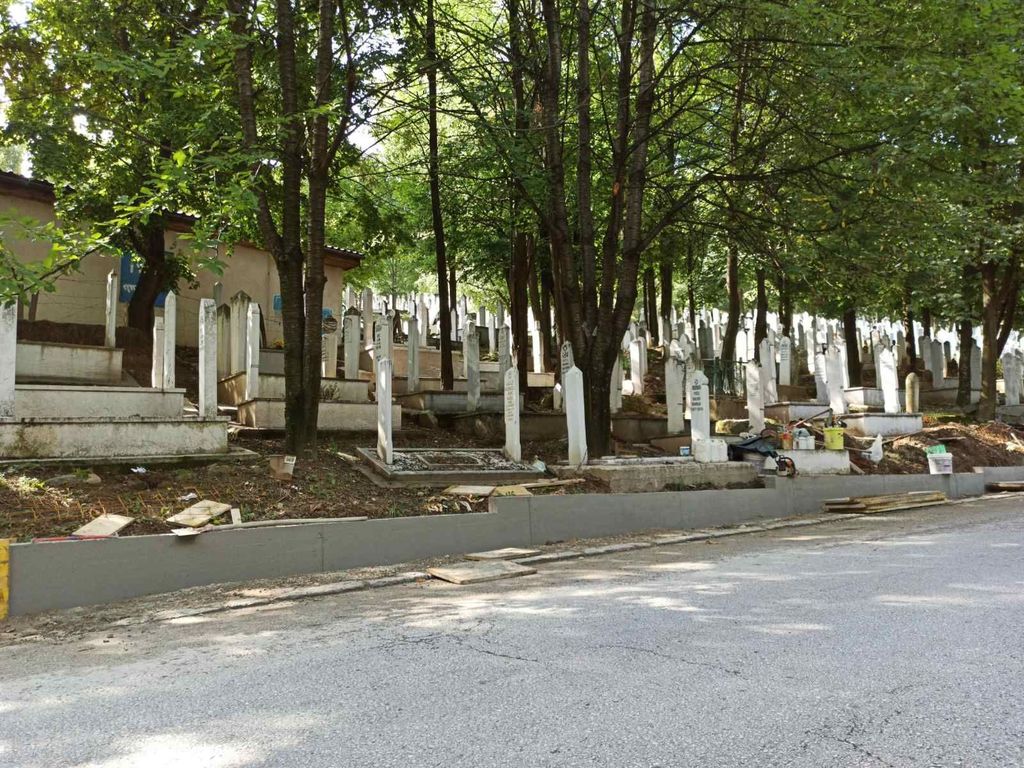
Mezarje Širokača - Hambina carina - Cemetery Link:
https://rip.live/cemetery/mezarje_sirokaca_hambina_carina_4978 - Country:
Bosnia and Herzegovina - Region:
Federation of Bosnia and Herzegovina - City:
Sarajevo - Local Address:
Sarajevo - Inscription:
The late Mullah Mustafa also died. For his soul (read) Fatiha. Year 1223" (1808-1809). - Map Link:
https://maps.google.com/maps/dir/?api=1&destination=43.8515305,18.4244422





 English
 Arabic
 French
 Spanish
 Deutsch
 Turkish
 Dutch
Dutch
 Italiano
 Russian
 Română
 Portuguese (Brazil)
 Greek
Greek
