


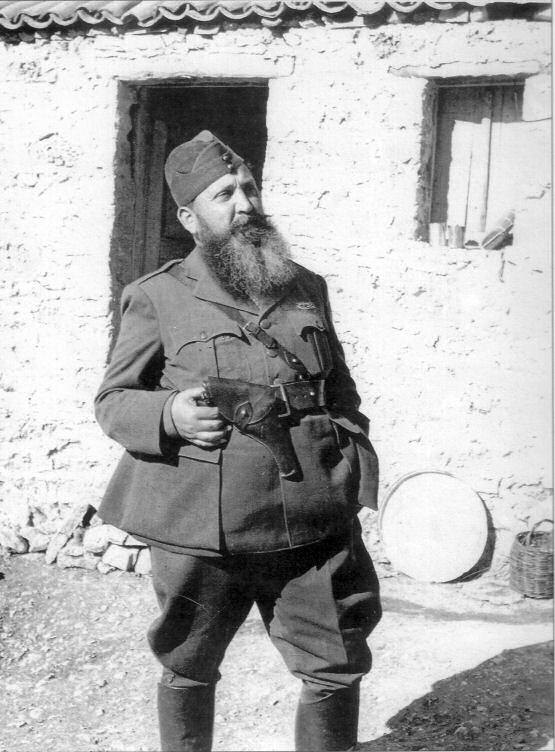
Greek: Ναπολέων Ζέρβας Army officer, resistance leader, politician, who "Cleansed" Greece of thousands of Cham Albanians. "General" is a self-conferred or honorary rank. In 1932, he was retired as a lieutenant colonel. He was not officially a general officer in active service. The Government of National Unity awarded him the honorary rank of major general in 1944. During World War II he organized and led the National Republican Greek League (EDES) - [Greek: Εθνικός Δημοκρατικός Ελληνικός Σύνδεσμος (ΕΔΕΣ)], the second most significant (after EAM/ELAS), in terms of size and activity, resistance organization against the Axis Occupation of Greece. In November 1942, the forces of EDES and those of ELAS (under the command of Aris Velouchiotis), in collaboration with a small group of British expert saboteurs, blew up the Gorgopotamos Bridge. For most of the rest of the war EDES and ELAS were engaged in an internecine conflict to replace the Nazis as masters of Greece. According to uncorroborated German sources, in February 1944, Zervas and XXII Mountain Corps commander General Karl Hubert Lanz (the war criminal responsible for the Cephalonia and Corfu massacres of Italian prisoners) reached a "gentlemen's agreement". Under its terms the two sides were to enter a truce, exchange limited information on ELAS prior to each side's military operations against the communists and enter full on collaboration in case EDES found itself on the brink of collapse. Upon their departure from Epirus, the Germans ensured that leftover materiel would reach the hands of EDES rather than ELAS. After the Nazi retreat, in 1944/1945 he "Ethnically Cleansed" Greece of thousands of Cham Albanians from settlements of the Chameria region of Epirus. In the process between 200 and 300 Chams were massacred by EDES forces in various settlements between March and May 1945, while over 1,200 were murdered in total. Moreover, according to Albanian sources, an additional 2,500 Muslim Cham refugees lost their lives through starvation and epidemics on their way to Albania. During late 1944 and 1945, Zervas and EDES were also responsible for the expulsion of the entire Muslim Cham Albanian minority, about 20,000 strong, from the Greek region of Epirus. The Chams, little integrated into Christian Greek society, had been a subject of Italian-sponsored Albanian irredentism both before and during the war, while a large part had collaborated with the Axis. In June 1944, after a short-term conflict against the combined Cham-German forces, the town Paramythia, in Thesprotia was liberated and violent reprisals were carried out against the town's Muslim community. In late summer 1944, EDES carried out attacks, accompanied by much violence and looting, against the Chams, which caused most of them to flee across the border to Albania. After World War II, Zervas founded the National Party of Greece and at the elections of 31st of March 1946, he was elected as representative of the Ioannina district in the Hellenic Parliament, while his party gained 25 seats in it. Later, he participated in Dimitrios Maximos' cabinet as Minister without portfolio, from 24 January to 23 February 1947, and afterwards as Minister for Public Order until 29 August 1947. The United States of America and the United Kingdom opposed his appointment suspecting him of collaboration with Nazi Germany during World War II and dictatorial ambitions. Some leftist writers believe that Zervas collaborated with the Germans to face ELAS. However, most writers consider that the Germans made fake documents to provoke disbelief and suspicion among resistant groups of Greece, and take advantage of their mini civil wars, which weakened them furthermore. As a Minister for Public Order, Zervas initiated inefficient reforms of the gendarmerie and ordered mass arrests of Communists. When he was replaced, Dwight Griswold, head of the U.S. economic mission in Greece, said, "I feel he is making more Communists than he is eliminating". A few years later, Zervas merged his party with the Liberal Party and was re-elected as representative of Ioannina in the Parliament. He then served as Minister of Public Works in Sophoklis Venizelos' cabinets from 2 September 1950 to 30 September 1951, also holding the portfolio of Merchant Marine until 1 February 1951. He did not manage his re-election in the Parliament at the next elections and withdrew from politics. He died in Evangelismos Hospital, Athens, of heart failure. His brother claimed that Napoleon Zerbas had been poisoned by British Intelligence, but this was dismissed after toxicological tests. His funeral was held at the Metropolitan cathedral of Athens with all of the honours bestowed on Government Ministers (he was an ex-minister), and he was buried at public expense in the First Cemetery.
- Name: Napoléon N. Zérvas
- Birth: 17/05/1891 (Arta, Regional unit of Arta, Epirus, Greece)
- Death: 10/12/1957 (Athens, Regional unit of Athens, Attica, Greece)
- Died at 66
- Veteran: yes
- 1 Postări
- 14 Fotografii
- 0 Video
- Lived in Athens, Regional unit of Athens
Cemetery Info
- Memorial QR JPG File:
https://rip.live/content/uploads/photos/2025/04/greece/attica/athens_regional_unit_of_athens/athens_first_cemetery_2777/graves/napoleon_n_zervas_58223/qr/napoleon_n_zervas_58223_qr.jpg - Cemetery Title:
Athens First Cemetery - Cemetery Link:
https://rip.live/cemetery/athens_first_cemetery_2777 - Country:
Greece - Region:
Attica - City:
Athens, Regional unit of Athens - Local Address:
Athens - Plot Address:
Section 4, Number 70 - Inscription:
ΝΑΠΟΛΕΩΝ Ν. ΖΕΡΒΑΣ ΓΕΝΙΚΟΣ ΑΡΧΗΓΟΣ ΕΘΝΙΚΩΝ ΟΜΑΔΩΝ ΕΛΛΗΝΩΝ ΑΝΤΑΡΤΩΝ ΕΔΕΣ 1941 – 1945 {Napoleon N. Zervas Commander in Chief National Greek Guerrilla Forces EDES 1941- 1945} - Map Link:
https://maps.google.com/maps/dir/?api=1&destination=37.96469,23.73555




 English
 Arabic
 French
 Spanish
 Portuguese
 Deutsch
 Turkish
 Dutch
Dutch
 Italiano
 Russian
 Portuguese (Brazil)
 Greek
Greek

Actualizări recente
More Stories