

Otakar Borůvka a adăugat o fotografie
acum 3 luni
R.I.P
Otakar
Otakar
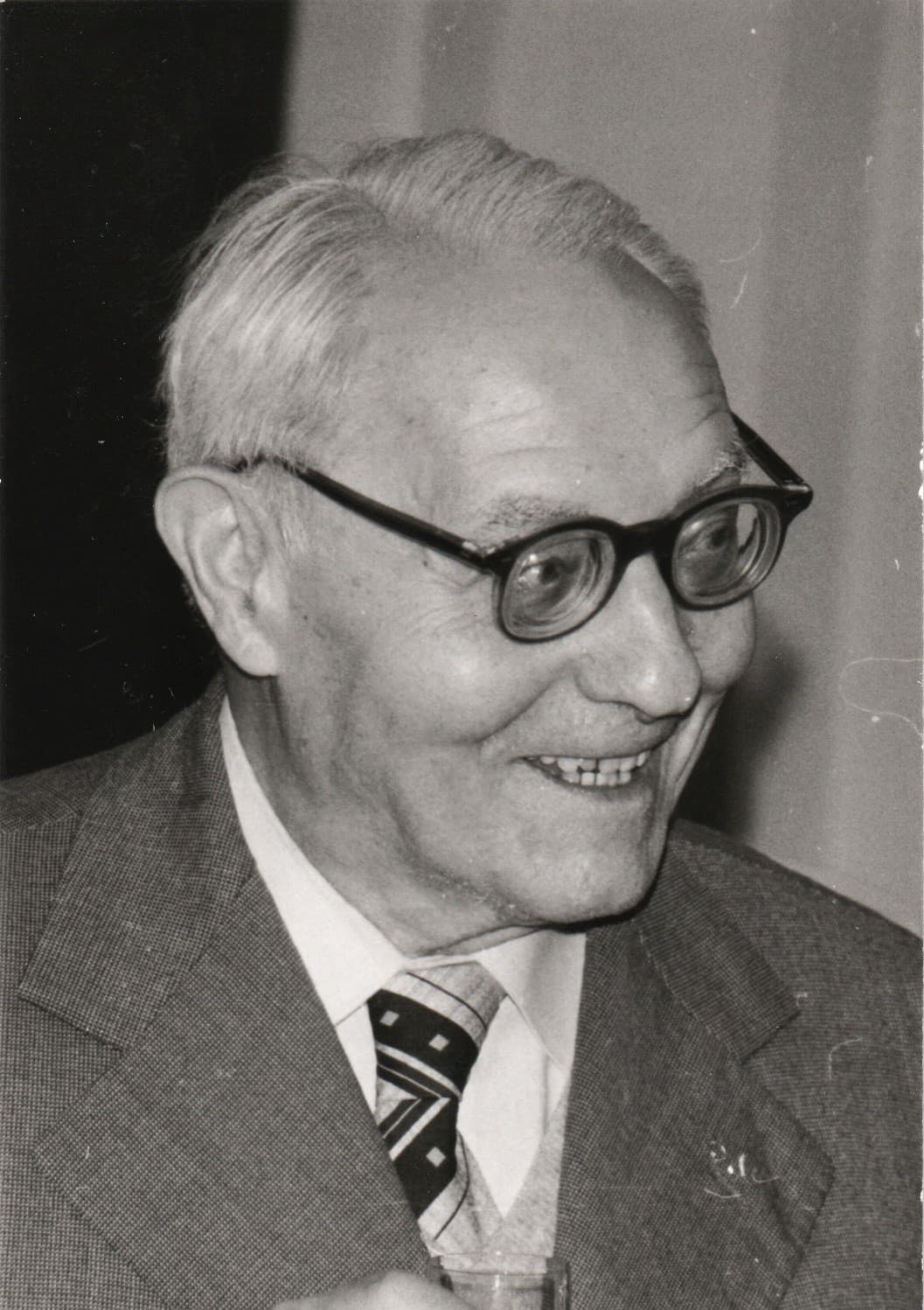
Otakar Borůvka (10 May 1899 – 22 July 1995) was a Czech mathematician. He is best known for his work in graph theory.
0 comentarii0 reacții
 🔍 Mărește
In memoriam
Otakar Borůvka (10 May 1899 – 22 July 1995) was a Czech mathematician. He is best known for his work in graph theory.
Otakar Borůvka a adăugat o fotografie
acum 3 luni
Otakar Borůvka (10 May 1899 – 22 July 1995) was a Czech mathematician. He is best known for his work in graph theory.
Otakar Borůvka a adăugat o fotografie
acum 3 luni
Education and career Borůvka was born in Uherský Ostroh, a town in Moravia, Austria-Hungary (today in the Czech Republic), the son of a school headmaster. He attended the grammar school in Uherské Hradiště beginning in 1910. In 1916, influenced by the ongoing World War I, he moved to the military school (Realschule) in Hranice, and later he enrolled into the Imperial and Royal Technical Military Academy in Mödling near Vienna. When the war ended, Borůvka returned to Uherské Hradiště, finished his studies in 1918 at the Gymnasium there, and became a student at the Imperial Czech Technical University of Franz Joseph, in Brno, initially studying civil engineering. In 1920, Masaryk University opened in Brno, and Borůvka also began taking courses there. He became an assistant to Mathias Lerch at Masaryk in 1921, but Lerch died in 1922; his position at Masaryk was taken by Eduard Čech, whom Borůvka also assisted, earning his doctorate in 1923. At Čech's suggestion, Borůvka visited Élie Cartan in Paris from 1926 to 1927. He earned his habilitation from Masaryk University in 1927, and (turning down an offer from the University of Zagreb) he became a docent there in 1928. He continued to travel abroad through…
Otakar Borůvka a lăsat un gând
acum 3 luni
Contributions The problem of designing efficient electric distribution networks had been suggested to Borůvka by his friend Jindřich Saxel, an employee of the West Moravian Power Company, during World War I. In his 1926 paper O jistém problému minimálním (English On a certain minimal problem), Borůvka solved this problem by modeling it mathematically as a minimum spanning tree problem, and described the first known algorithm for finding the minimum spanning tree of a metric space (the set of cities to be connected by the network, together with their distances). Now called Borůvka's algorithm, his method works by repeatedly adding a connections between each subtree of the minimum spanning tree found so far and its nearest neighboring subtree. The same algorithm has been rediscovered repeatedly. It is more suitable for distributed and parallel computation than many other minimum spanning tree algorithms, can achieve linear time complexity on planar graphs and more generally in minor-closed graph families, and plays a central role in the randomized linear time algorithm of Karger, Klein & Tarjan (1995). From 1924 to 1935, Borůvka's primary interest was in differential geometry. His work in this area concerned analytic correspondences between projective planes, normal curvature of high-dimensional surfaces, and…
Otakar Borůvka a lăsat un gând
acum 3 luni
Awards and honors Borůvka became a corresponding member of the Czechoslovak Academy of Sciences at its creation in 1953, and an ordinary member in 1965. In 1969, Comenius University in Bratislava gave him an honorary doctorate, and in 1994 he received a second honorary doctorate from Masaryk University in Brno. He has also been given medals by the Free University of Brussels, the University of Liège, Jagiellonian University, Comenius University, Palacký University of Olomouc, Jan Evangelista Purkyně University in Ústí nad Labem, the German Academy of Sciences at Berlin, the Russian Academy of Sciences#Academy of Sciences of the USSR, and the Czechoslovak Academy of Sciences.