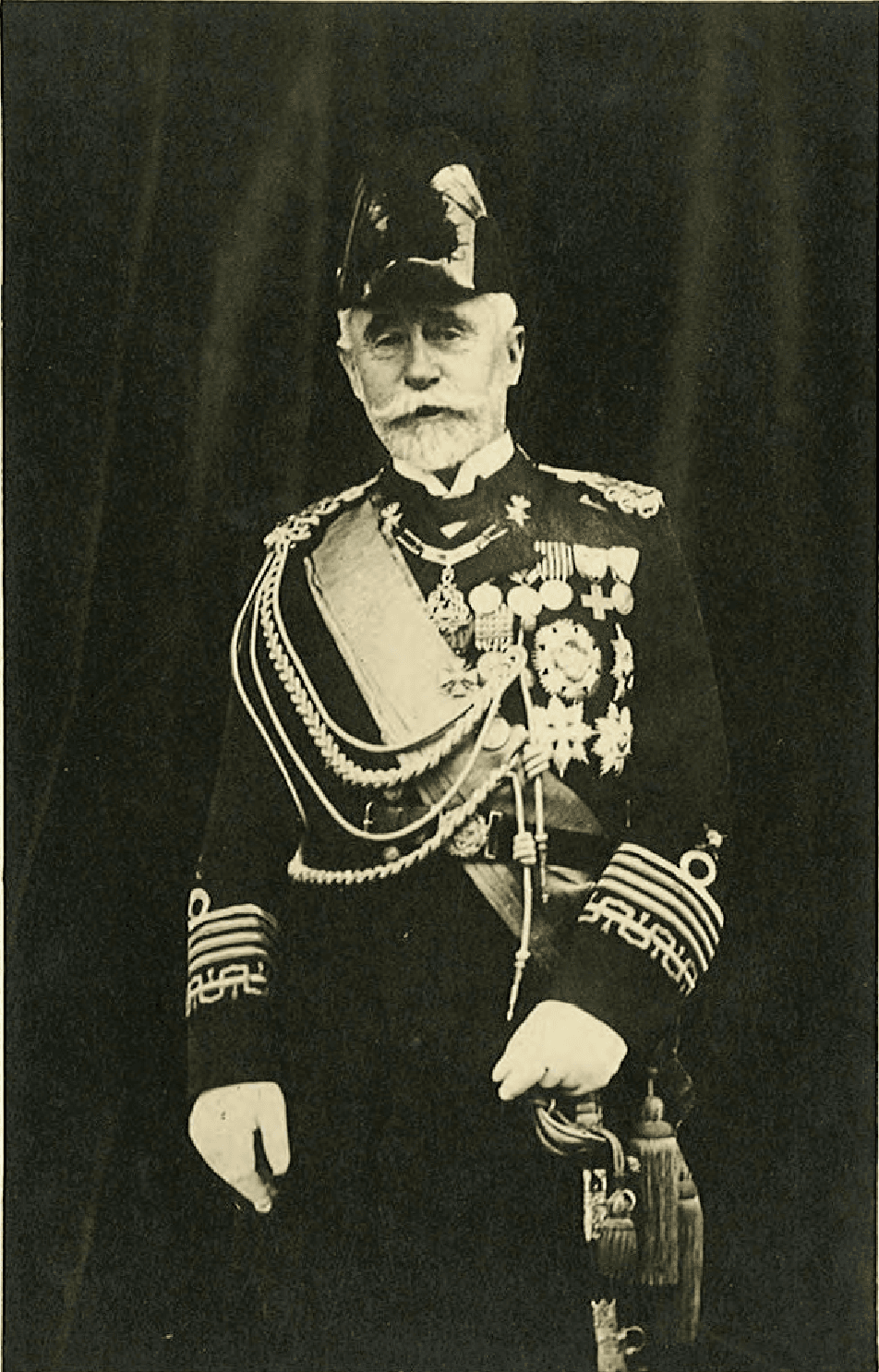
Paolo Camillo Thaon, Marquess of Revel (10 June 1859 – 24 March 1948), latterly titled with the honorary title of 1st Duke of the Sea, was an Italian admiral of the Regia Marina during World War I and later a politician.
Paolo Camillo Thaon, Marquess of Revel (10 June 1859 – 24 March 1948), latterly titled with the honorary title of 1st Duke of the Sea, was an Italian admiral of the Regia Marina during World War I and later a politician.
0 comentarii0 reacții
Paolo Emilio Thaon di Revela adăugat o fotografie
acum 3 luni
R.I.P Paolo
Early life and career
Thaon di Revel was born in Turin from a family of the Savoyard and Niçard nobility of Scottish descent, a younger son of Marquess and Count Ottavio Thaon di Revel and nephew of Genova Giovanni Thaon di Revel.
He took part as Rear-admiral in the Italo-Turkish War, commanding Italian cruisers in the Battle of Beirut.
He was named Chief of Staff of the Regia Marina in 1913; he supported the signing of a naval convention between the nations of the Triple Alliance, knowing of Italy's vulnerability to seaborne threats and its dependence on its sealanes, which was concluded on October of that year. When World War I broke out, he warned the government of Antonio Salandra that chances of Austro-Italian success against the combined force of the French and British fleets was small, and that the Regia Marina could not guarantee the safety of the Italian coast. This factors weighed in Salandra's decision to proclaim Italy's neutrality.
0 comentarii0 reacții
Paolo Emilio Thaon di Revela adăugat o fotografie
acum 3 luni
R.I.P Paolo
World War I When Italy joined the Entente on 24 May 1915, Thaon di Revel became the leading figure of Italy's naval war, and remained so for the duration. He resigned in October 1915 because of friction between him and the Minister of the Navy Camillo Corsi over the respective authority, and took command of the naval base of Venice. On 3 February 1917, he was reappointed Chief of Staff, and combined the position with that of Commander in Chief of the mobilized naval forces (i.e. the Regia Marina's main forces), replacing Prince Luigi Amedeo, Duke of the Abruzzi. On one hand, Thaon di Revel was "energetic and autocratic", a tireless defender of perceived allied indifference towards Italian needs and merits and of Italian independent command, and the major reason as to why a unified Mediterranean naval command never came to be (which would have led to dangerous ambiguity had a combined fleet action been imminent), which led to a less than optimal relationship with the allied navies and officers; however, he was also "thoroughly realistic", having a picture of the Adriatic theater that discouraged aggressive actions to lure out the Austrian fleet, and which led to his decision not…
0 comentarii0 reacții
Paolo Emilio Thaon di Revela lăsat un gând
acum 3 luni
Later life
In 1917 Thaon di Revel was named to the Senate of the Kingdom of Italy. In November 1921, while serving as the Chief of the Italian Naval Staff, he was Italy's naval representative to the Washington Armaments Conference.
In 1922, he was ennobled by King Victor Emmanuel III and given the victory title of 1st Duca del Mare ("Duke of the Sea"). In October 1922 he was appointed Minister of the Navy in the Mussolini Cabinet; he resigned in 1925, to protest the creation of the position of Chief of the General Staff, to be assigned exclusively to Army officers. He was named Grand Admiral (Grande Ammiraglio) on 4 November 1924. He was President of the Italian Senate from 1943 to 1944 after the fall of fascist regime.
Thaon di Revel died in Rome in 1948. He was buried in the church of Santa Maria degli Angeli e dei Martiri, next to General Armando Diaz.
0 comentarii0 reacții
Paolo Emilio Thaon di Revela lăsat un gând
acum 3 luni
Bibliography
Halpern, Paul G. (1994). A naval history of World War I. Annapolis, Md.: Naval Institute Press. ISBN 9781612511726.
Ferrante, Ezio (2018). Il Grande Ammiraglio Paolo Thaon di Revel. Ufficio Storico della Marina Militare. ISBN 978-88-99642-15-0.