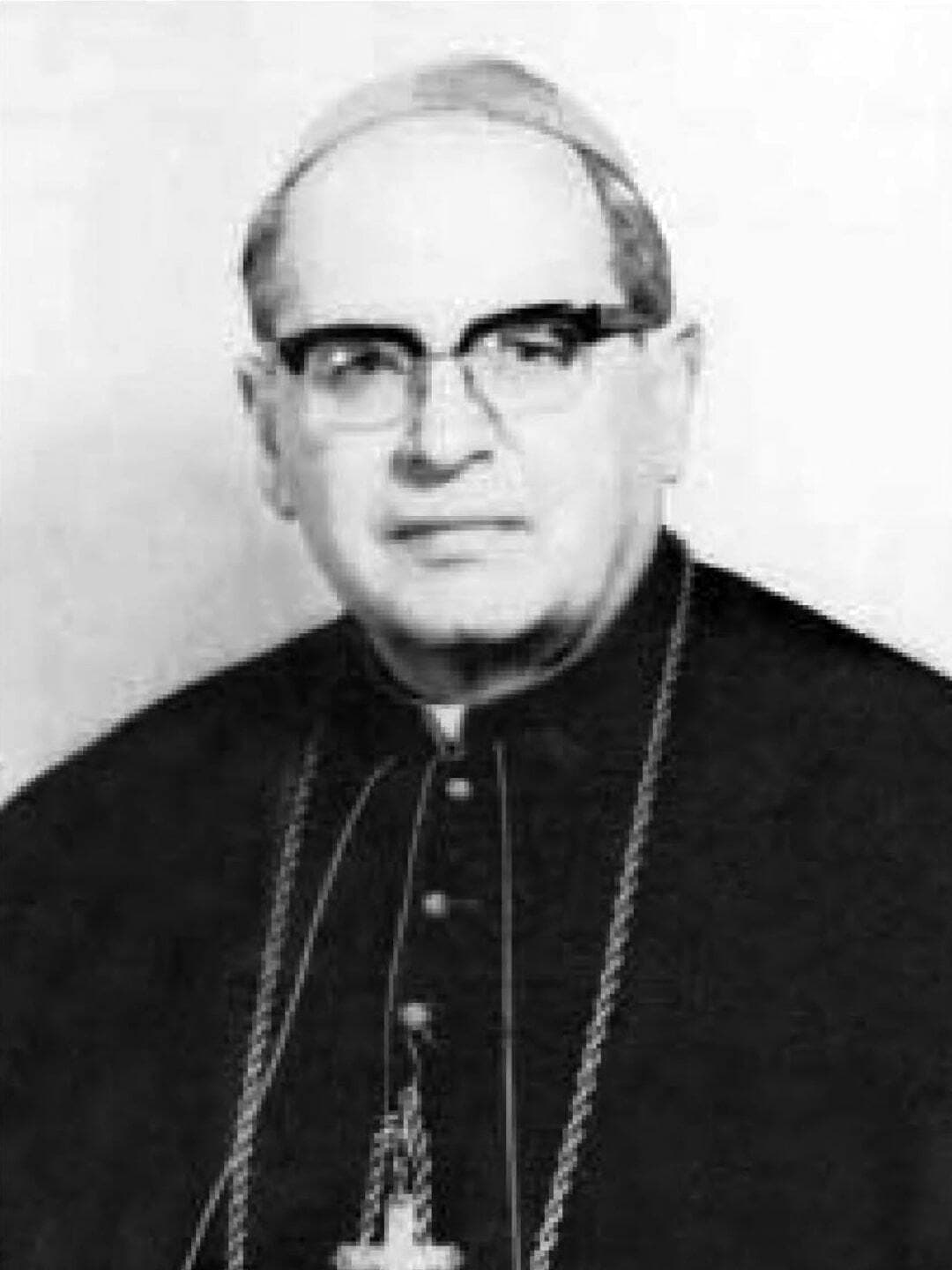
Pavao Žanić (20 May 1918 – 11 January 2010) was a prelate of the Catholic Church who served as the Bishop of Mostar-Duvno and apostolic administrator of Trebinje-Mrkan from 1980 until his retirement in 1993. Previously, Žanić served as bishop coadjutor of Mostar-Duvno and titular Bishop of Edistania from 1970 until 1980. He also served as apostolic administrator of Dubrovnik from 1988 until 1990. During Žanić's episcopate, the reports of Marian apparitions in Medjugorje occurred in 1981. Although initially sympathetic towards the visionaries, Žanić became a fierce opponent of the Medjugorje ph
Pavao Žanić (20 May 1918 – 11 January 2010) was a prelate of the Catholic Church who served as the Bishop of Mostar-Duvno and apostolic administrator of Trebinje-Mrkan from 1980 until his retirement in 1993. Previously, Žanić served as bishop coadjutor of Mostar-Duvno and titular Bishop of Edistania from 1970 until 1980. He also served as apostolic administrator of Dubrovnik from 1988 until 1990. During Žanić's episcopate, the reports of Marian apparitions in Medjugorje occurred in 1981. Although initially sympathetic towards the visionaries, Žanić became a fierce opponent of the Medjugorje phenomenon. He believed that they were a Franciscan manipulation and a hoax. Žanić created two commissions to evaluate the authenticity of the apparitions, and the commission declared that it could not establish that the events in Medjugorje were supernatural. In the Herzegovina Affair, a dispute between the Franciscans and the Diocese of Mostar-Duvno, Žanić tried to enforce Romanis Pontificibus, the papal decree on the division of parishes, which rendered that half of the parishes should be given to the diocesan clergy, while the Franciscans would administer another half. The decree met fierce opposition from the Franciscans, which led many of them to be expelled from the Franciscan Order in…
0 comentarii0 reacții
Pavao Žanića adăugat o fotografie
acum 3 luni
R.I.P Pavao
Biography Žanić was born in Kaštel Novi (present-day Croatia) to father Jerko and mother Tona née Franić. He also had two brothers, one senior – Marin, and the other younger – Fabijan, and two sisters Jerka and Jozica. Žanić received a Christian upbringing and attended religious classes. He also served as an altar boy in his parish church. Žanić attended primary school in his hometown from 1924 to 1929 and was noted as an intelligent and hard-working child. Following his wish to become a priest, at the delight of his parents, he was sent to a classical gymnasium in Split, where he spent eight years, where he was also prominent for his talent, work and religiosity. He was especially interested in music and mechanics. Franić graduated from the gymnasium in 1937. He continued his philosophical and theological studies in Split from 1937 to 1941 and was ordained a priest by the local bishop Kvirin Bonefačić in Split, on June 1, 1941. He was ordained a priest on 1 June 1941. His first assignment was as a parish priest at Šolta. In 1952 he became administrator of Rogotin. The sick parish priest of the Split cathedral Mladen Alajbeg and proposed Žanić…
0 comentarii0 reacții
Pavao Žanića lăsat un gând
acum 3 luni
Diocesan dispute
For centuries parishes in Bosnia-Herzegovina were administered by the Franciscan order under an understanding reached with the Ottoman sultan.
After Herzegovina became part of the Austro-Hungarian empire, Pope Leo XIII took steps to establish dioceses and appoint local bishops. As part of re-establishing normal church structures, the bishops worked to transfer parishes from the Franciscans to the diocesan clergy, but the friars resisted. In the 1940s, the two Franciscan provinces still held 63 of 79 parishes in the dioceses of Vrhbosna and Mostar.
In June 1975 Pope Paul VI issued Romanis Pontificibus, a papal decree indicating which parishes the Franciscans were allowed to retain and which to turn over to diocesan administration. Beginning in 1976 Bishop Žanić started to implement the decree. Full implementation was still being worked on as late as December 1998.
0 comentarii0 reacții
Pavao Žanića lăsat un gând
acum 3 luni
Medjugorje On 24 June 1981, six adolescents reported having visions of the Madonna on a hill in the village of Medjugorje. The local communist authorities reacted two days later, subjecting the visionaries to interrogation and the next day to a psychiatric evaluation of which the visionaries were found to be healthy. Because of the growing gatherings at the reported vision site, the authorities implemented a state of emergency and started persecuting those who supported the alleged apparitions. According to Marijana Belaj, revolted by the treatment of the Franciscans and the faithful by the authorities and the media, Žanić sent a protest note to the President of the Presidency of Yugoslavia Sergej Kraigher on 1 September 1981, asking him to react "irresponsible slanders and attacks" by which "basic civic and human rights are being assaulted". According to Randall Sullivan, in the beginning, Zanic was sympathetic and protective of the young visionaries and on July 25, 1981, he made a statement to the press: "No one has forced them or influenced them in any manner. These are six normal children; they are not lying; they express themselves from the depths of their hearts. Are we dealing here with a personal vision or…