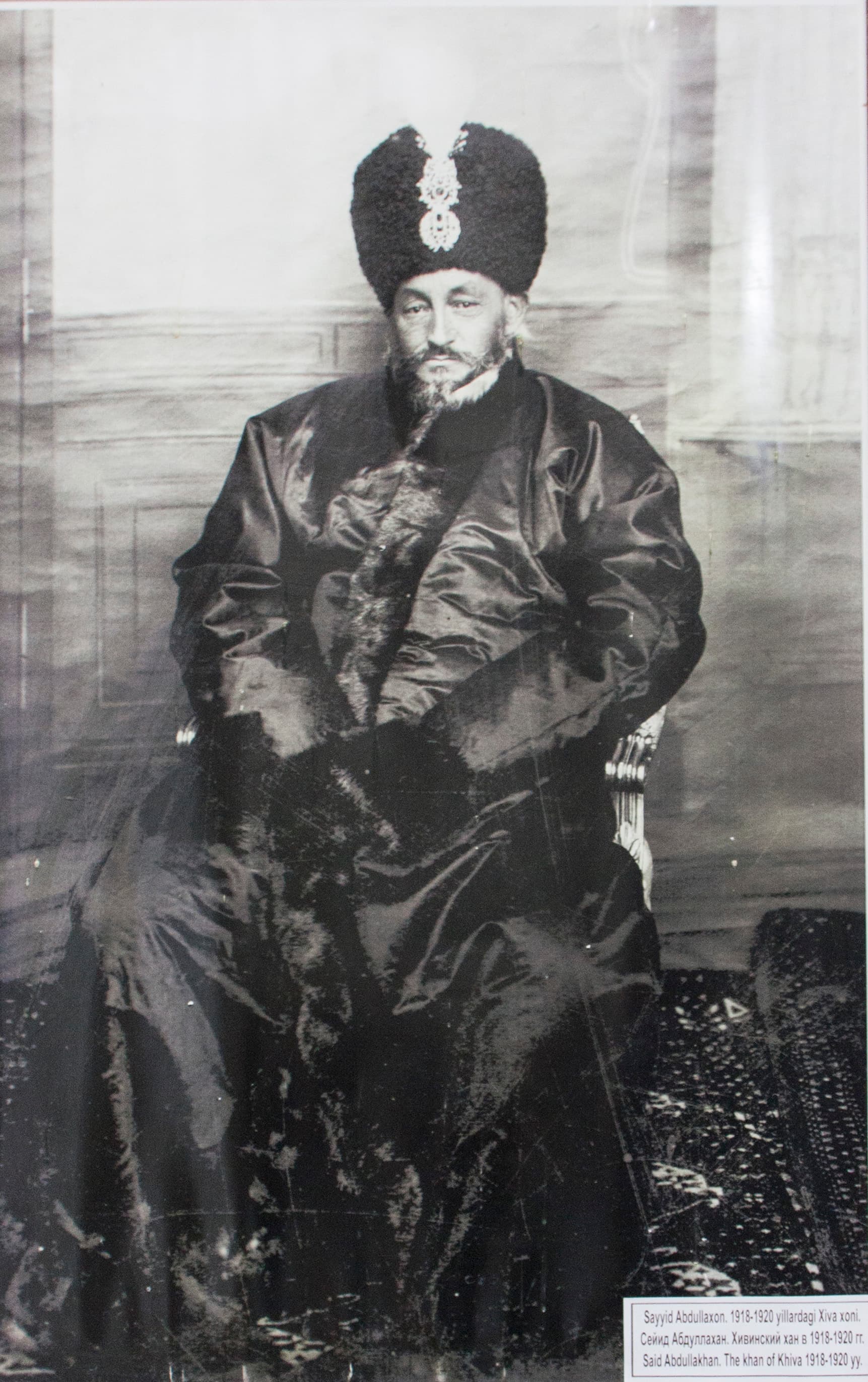
Sayid Abdullah Khan (Turki and Persian: سید عبدالله خان; 1873–1933) was the last Khan of Khiva of the Khongirad (Qungrat) dynasty, from 1 October 1918 until 1 February 1920. His father was Muhammad Rahim Khan II.
Sayid Abdullah Khan (Turki and Persian: سید عبدالله خان; 1873–1933) was the last Khan of Khiva of the Khongirad (Qungrat) dynasty, from 1 October 1918 until 1 February 1920. His father was Muhammad Rahim Khan II.
0 comentarii0 reacții
Sayyid Abdullah Khan IIa adăugat o fotografie
acum 3 luni
R.I.P Sayyid
Biography Although a titular ruler, Sayid Abdullah had no real power because the Khanate was effectively controlled by the Basmachi leader Junaid Khan, a Turkmen general, following a coup in 1918. By 1920, the Bolsheviks had defeated Junaid Khan, overthrown the Khanate of Khiva and deposed Sayid Abdullah. He was sent to Ukraine, where he died 13 years later at a hospital. Ukrainian writer Grigory Jamalovich Huseynov in the early 1980s met with the descendants of Said Abdullah Khan, and conducted a study about the descendants of the Khan in Ukraine. In particular, he interviewed the nephew of Said Abdullah Khan, Abdurasul Mukhammedyarovych Madiyarov, who lived in Krivoy Rog, who told in detail the history and life of the Khan's descendants in Ukraine. Grigory Huseynov outlined the results of his research in the essay “How the Khan Worked at the Mine”. After abdicating the throne on February 2, 1920, Said Abdullah Khan and his family were arrested by the Bolsheviks. The trial of the Khan and his family began on June 12, 1920. Said Abdulla Khan and nine (according to other sources seven) of his closest male relatives were deported and exiled from the Khorezm People's Soviet Republic for a…
0 comentarii0 reacții
Sayyid Abdullah Khan IIa lăsat un gând
acum 3 luni
Death Said Abdulla Khan himself did not start a family in Krivoy Rog, and continued to work as a watchman at the Bolshevik mine. At the place of work, he had the nickname “Khan”, and most did not guess or believe that “Khan” was the last Khan of the State of Khorezm from the Qungrat dynasty. In 1932, a massive famine (known as the Holodomor) began in the Ukrainian SSR and in 1933, Said Abdullah Khan fell ill and was admitted to the mine hospital, where he was diagnosed with dysentery, and died a month later from a prolonged illness and malnutrition. He was buried in the mine cemetery. The elder brother of Said Abdullah Khan, Muhammadyar, was elderly at the time of his arrival during the exile, approximately 70 years old. He could not work and after the onset of the severe famine, he was forced to beg. The younger brother of Said Abdullah Khan - Ibadulla, who was also expelled from Khorezm, was deaf from childhood and, unable work throughout his life, also took to begging at the local market next to the mine shop. By the summer of 1934, Ibadullah was also severely malnourished, and died after…
0 comentarii0 reacții
Sayyid Abdullah Khan IIa lăsat un gând
acum 3 luni
Descendants In 1933, the exiles were allowed to return to Central Asia or settle in other parts of the USSR without restrictions, and the sons of Said Abdulla Khan - Rahmatullah and Yusuf Yakub moved to Tashkent, where some of their relatives lived. After arriving in Tashkent, they sent a letter to Krivoy Rog and reported their whereabouts. Muhammadyar, the elder brother of Said Abdullah Khan, decided to return to Khiva, but reaching Tashkent, he was again forced to resort to begging, and died there in 1936, never reaching his native Khiva. The Khan's son, Said Abdulla, moved with his wife to Tashkent, where he worked as a translator. Later he moved to the city of Osh and worked in exploration. In later years, he began to drink, and in 1941 he knocked down a man and was sentenced to five years in the labor camps. His wife returned to Krivoy Rog in 1944. Said Abdullah died in the early 1960s. Throughout the Soviet era, all exiles continued to be prohibited from re-entering Khiva, while there were no restrictions on entry to the rest of the USSR. After 1934, only the brothers Nasyr and Abdurasul remained in Krivoy Rog. Nasyr…