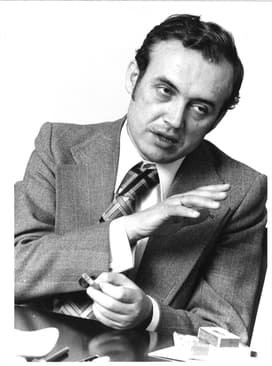
Stipe Šuvar (17 February 1936 – 29 June 2004) was a Croatian politician and sociologist who was regarded to have been one of the most influential communist politicians in the League of Communists of Croatia (SKH) in SR Croatia in the 1980s during Yugoslavia. He entered top politics in 1972 being co-opted to the Central Committee of SKH. Two years later he became SR Croatia's minister of education and performed a controversial educational reform in Croatia. In 1980s he was a member of the Presidency of SKH central committee, then a member and President of the Presidency of the Central Committee
Stipe Šuvar (17 February 1936 – 29 June 2004) was a Croatian politician and sociologist who was regarded to have been one of the most influential communist politicians in the League of Communists of Croatia (SKH) in SR Croatia in the 1980s during Yugoslavia.
He entered top politics in 1972 being co-opted to the Central Committee of SKH. Two years later he became SR Croatia's minister of education and performed a controversial educational reform in Croatia. In 1980s he was a member of the Presidency of SKH central committee, then a member and President of the Presidency of the Central Committee of the League of Communists of Yugoslavia (SKJ).
In 1989, Croatian Parliament appointed Šuvar to represent SR Croatia in the eight-member Presidency of Yugoslavia but dismissed him one year later when, after the first multi-party elections in Croatia, it was already dominated by the Croatian Democratic Union (HDZ) of Franjo Tuđman.
After the collapse of communism and the breakup of Yugoslavia, Šuvar founded the now defunct magazine Hrvatska ljevica (1994–2005) and a minor leftist party, the Socialist Labour Party of Croatia (SRP). Šuvar was known as a lifelong Marxist ideologue and opponent of nationalism.
0 comentarii0 reacții
Stipe Šuvara lăsat un gând
acum 3 luni
Academic work and early political career
Šuvar was born in 1936 in the Dalmatian village of Zagvozd. At the age of 19, he joined the League of Communists of Yugoslavia (SKJ). He studied at the University of Zagreb Faculty of Law, where he received a sociology doctorate in 1965. From 1960 until the 1980s he taught sociology at the University of Zagreb and at other universities in Yugoslavia, and published a number of books on both sociological and political topics.
From 1963 to 1972, he was editor-in-chief of the Zagreb monthly Naše teme. In 1969, Šuvar in a polemic with Matica hrvatska official Šime Đodan denied the claims by Maspok ideologists that Croatia was being exploited by other Yugoslav republics. During time Šuvar was also active in several other periodicals, lastly in SKJ-run "Socijalizam" (Socialism) in the 1980s.
In 1972, after the Maspok had been defeated and the leadership led by Mika Tripalo purged from the top of SKH, Šuvar was co-opted to the SKH central committee. Two years later he became Croatian secretary (minister) for culture and education and remained in that office until 1982.
0 comentarii0 reacții
Stipe Šuvara lăsat un gând
acum 3 luni
The White Book
From 1982 to 1986, Šuvar was a member of the Presidium of SKH. From 1983 onwards, he was responsible for the ideological section of the party and, holding this office, in 1984 he organized a discussion about the "ideological struggle on the cultural front." Participants of the meeting were handed materials containing quotations from texts of 186 (mostly Serbian and Slovenian) authors which had been published in the Yugoslav media between 1982 and 1984. These texts were labeled as unacceptable, anti-socialist and more or less "openly nationalist." The document, nicknamed the White Book (B(ij)ela knjiga) or "Flowers of Evil" (Cv(ij)eće zla), was condemned especially by the Serbian intelligentsia as a Stalinist attack on freedom of thought.
0 comentarii0 reacții
Stipe Šuvara lăsat un gând
acum 3 luni
SKJ leadership In 1986, Šuvar was elected to the SKJ Presidium as a representative of the Croatian SKH along with Ivica Račan. In June 1988, when the Presidium was about to choose a new chairman between Šuvar and Račan, Šuvar prevailed. At the vote he was backed up, among others, by the Serbian members of the Presidium including Slobodan Milošević. However, only one month later controversies between Šuvar and Milošević emerged because of Šuvar's opposition to the anti-bureaucratic revolution organized by the Serbian leader. In October 1988, when a dispute between Šuvar and Milošević at one Presidium session went public, a campaign for Šuvar's dismissal took place in Serbia. In early October 1988, rallies in Novi Sad supported by Milošević forced out the local Vojvodina party leadership, while Montenegrin establishment, with the support of the SKJ Presidium and of the federal Presidency, resisted rallies in Titograd. On 17 October, in the heated political atmosphere, the SKJ Central Committee met at its 17th plenary session in Belgrade to discuss "general political situation" in Yugoslavia. Yugoslav media expected the session to be crucial for country's future and also more than 200 foreign journalists were about to attend the plenum. In his address,…
0 comentarii0 reacții
Stipe Šuvara lăsat un gând
acum 3 luni
Member of the Presidency of Yugoslavia
In the spring of 1989, the Croatian Parliament appointed Šuvar to represent SR Croatia in the Yugoslav Presidency, the collective body serving as head of state of Yugoslavia. In April 1990 multi-party parliamentary elections took place in Croatia, in which Franjo Tuđman's recently formed HDZ won on an independence platform. Tuđman asked Šuvar to resign, but he refused; on 24 August 1990 Croatian Parliament dismissed Šuvar from the Yugoslav Presidency, choosing Stipe Mesić of HDZ in his place.
On that occasion in the Parliament, Šuvar held his last speech while holding a political office. He warned against hostilities and possible ethnic conflicts in Yugoslavia and in Croatia, called for a new agreement on Yugoslavia or for its peaceful dissolution, and for respecting rights of ethnic Serbs living in Croatia. He expressed the hope for a new rise of the left in its struggle for socialism, and ironically congratulated HDZ for completing the Serbian-driven anti-bureaucratic revolution by eliminating him from politics. The speech was twice interrupted by an uproar of the HDZ deputies and followed by sharply critical replies of several of them, while nobody of Šuvar's own SKH party spoke in his defence.
0 comentarii0 reacții
Stipe Šuvara lăsat un gând
acum 3 luni
Later years On 1 November 1990, he left SKH just two days before the party convention in which they were reformed as a social democratic party. He stated his reasons in a letter saying that the new SDP-SKH was no longer "a left-wing or a revolutionary party" but an "ordinary civil party" just like the rest of the political spectrum. After he had left politics, Šuvar returned to Zagreb University as a professor of sociology. In 1994 he founded the magazine Hrvatska ljevica (The Croatian Left) and in 1997, he returned to politics by creating the Socialist Labour Party of Croatia (SRP). Šuvar succeeded in bringing some respectable personalities into the fold, but SRP never managed to win more than 1% of the votes in parliamentary elections. He was the chairman of SRP until 2004, when, shortly before his death, he resigned. Šuvar was a vocal critic of nationalist policies of the regime of Franjo Tuđman in the 1990s which targeted Serbs of Croatia, especially after the 1995 Operation Storm. After 1990, Šuvar also continued publishing books, and gave a number of interviews in which he reflected on both his role in politics of former Yugoslavia and events after the…