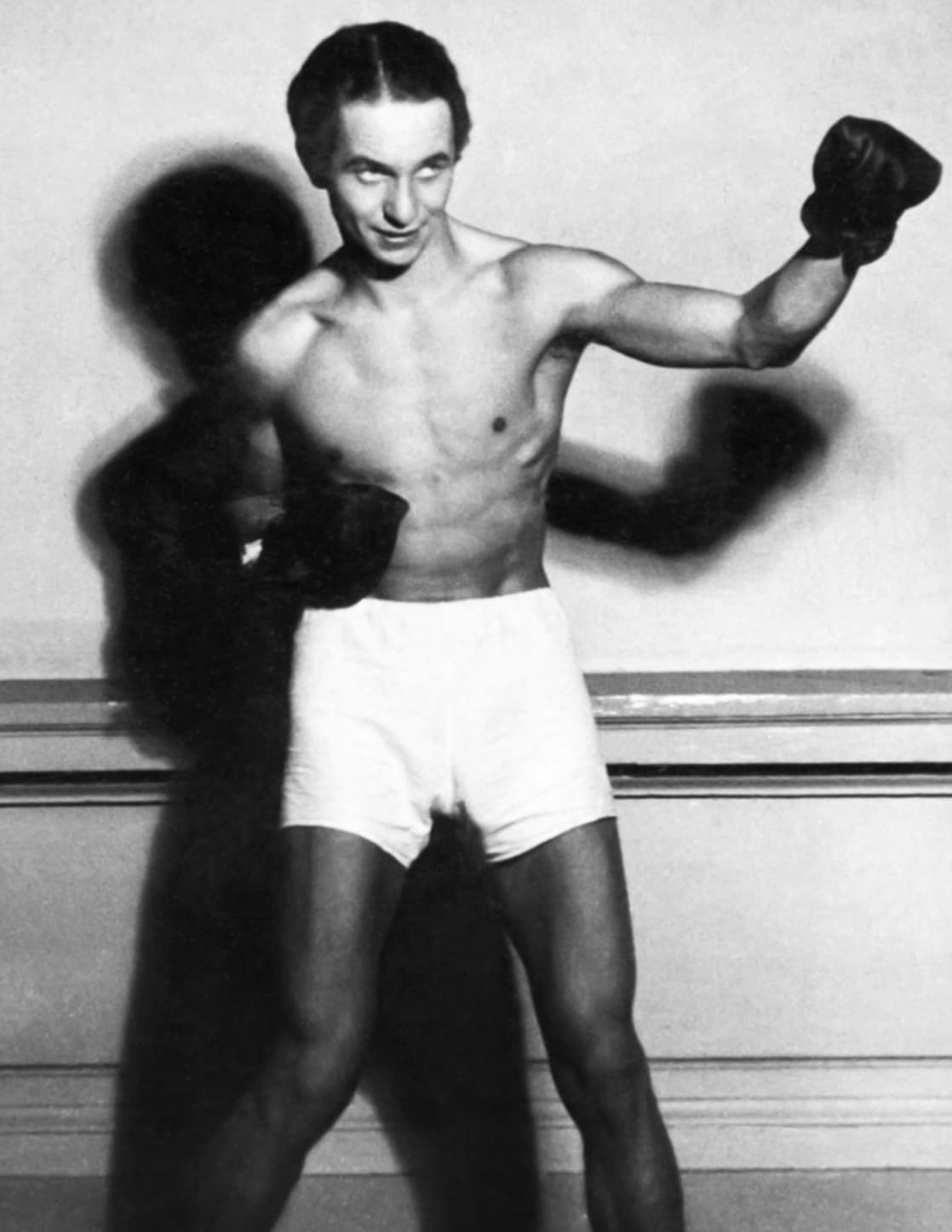
Tadeusz Pietrzykowski (Polish pronunciation: [taˈdɛ.uʂ pjɛtʂɨˈkɔfskʲi]; 8 April 1917 – 17 April 1991) was a Polish boxer, Polish Armed Forces soldier, and a prisoner at the Auschwitz-Birkenau and Neuengamme concentration camps run by the German Nazis during World War II. He was part of the first mass transport to Auschwitz in June 1940, and was transferred to Neuengamme in 1943. He is remembered as the boxing champion of Auschwitz. Pietrzykowski's life story has been the subject of several books and movies.
Tadeusz Pietrzykowski (Polish pronunciation: [taˈdɛ.uʂ pjɛtʂɨˈkɔfskʲi]; 8 April 1917 – 17 April 1991) was a Polish boxer, Polish Armed Forces soldier, and a prisoner at the Auschwitz-Birkenau and Neuengamme concentration camps run by the German Nazis during World War II. He was part of the first mass transport to Auschwitz in June 1940, and was transferred to Neuengamme in 1943. He is remembered as the boxing champion of Auschwitz. Pietrzykowski's life story has been the subject of several books and movies.
0 comentarii0 reacții
Tadeusz Pietrzykowskia adăugat o fotografie
acum 3 luni
R.I.P Tadeusz
Early life Pietrzykowski was born on 8 April 1917 in Warsaw to father Tadeusz, an engineer, and mother Sylwina (née Bieńkowska), a teacher, both members of the Polish intelligentsia. In his youth he joined the boxing section of the Legia Warsaw club, where he trained under Feliks Stamm. He received a number of positive write-ups in the interwar Polish sports press, and was nicknamed "Teddy" or "Teddi". He was at the height of his sports career in the years 1936 and 1937; in 1935 his boxing section advanced to the A-rank in Warsaw, and in 1937 he qualified for the finals in the Polish Boxing Championships and became the Warsaw Champion in the bantamweight class. A 1938 edition of the Polish sports magazine Przegląd Sportowy declared him "the best bantamweight boxer in Warsaw". Around that time he suffered an injury and was expelled from his school, and his boxing section was disbanded. Following the German invasion of Poland in September 1939, Pietrzykowski took part in the Siege of Warsaw, volunteering for a light artillery regiment. In early 1940, following the Polish defeat, he attempted to travel to France, where the Polish Army was being reformed. He was arrested in Hungary,…
0 comentarii0 reacții
Tadeusz Pietrzykowskia lăsat un gând
acum 3 luni
Life in the camps In March 1941, Pietrzykowski joined the Auschwitz resistance movement, Związek Organizacji Wojskowej, working directly under Witold Pilecki. A few months later he took part in an assassination attempt against a high-ranking German officer in the camp, commandant Rudolf Höss, by helping to sabotage the saddle of Höss' horse. The assassination attempt failed, but resulted in Höss breaking a leg. The incident was classified as an accident by the Germans, and the prisoners were not punished. Later, Pietrzykowski killed Höss' dog, which had been trained to attack Jewish prisoners and had killed at least one of them. The dog was cooked and eaten by the prisoners. Pietrzykowski was also involved in other resistance activities, such as passing information and sabotaging labor activities. He took part in his first unofficial boxing fight in the camp in March 1941, motivated by the promise of additional food rations. The match was against Walter Dünning, a German kapo and the German middleweight vice-champion. The match was judged by Bruno Brodniewicz. The fight was inconclusive, but Pietrzykowski was considered by many to be the winner as his opponent was better fed, better rested, and had a 40-to-70 kg weight advantage. His performance…
0 comentarii0 reacții
Tadeusz Pietrzykowskia lăsat un gând
acum 3 luni
After the war
After being liberated, Pietrzykowski joined the Polish 1st Armoured Division where he organized sport activities for the soldiers. He also sparred with other soldiers, winning his Division lightweight boxing championship in 1946. In 1947, he returned to Poland, where he testified in the trial of Rudolf Höss. He tried to restart his sport career, but developed illnesses and his official post-war match record is 15 victories and two ties.
Pietrzykowski was married three times. In 1959 he finished his studies at the University of Physical Education in Warsaw. In the 1960s, he settled in Bielsko-Biała, where he became a sport and physical education teacher, and boxing instructor. He died on 17 August 1991.
0 comentarii0 reacții
Tadeusz Pietrzykowskia lăsat un gând
acum 3 luni
Remembrance His life is the subject of two in-depth biographies.[a] Parts of Pietrzykowski's life, particularly his fight against Schally Hottenbach, served as the basis for a 1962 film by the Slovak director Peter Solan (Boxer a smrť - The Boxer and Death) with a script by Polish writer Józef Hen who would later write a book based on it (Bokser i śmierć, 1975). Pietrzykowski's story was also featured in a movie about famous Polish boxers, Ring Wolny (2018). Another movie about his life, The Champion, with Piotr Głowacki as the main protagonist, was announced in 2019 and was planned to premier in Poland in the autumn of 2020, but was delayed till spring 2021. In April 2020, the town council of Bielsko-Biała announced it would commemorate Pietrzykowski. There had been a street named after him in Bielsko-Biała, but it closed in 2008. In May 2021, an exhibition of Pietrzykowski's paintings entitled Tadeusz Pietrzykowski – A Warrior with an Artist's Soul, was opened at the Museum of the Second World War in Gdańsk. His story is also featured in Andrzej Fedorowicz's 2020 historical book Gladiatorzy obozów śmierci (The Gladiators of the Death Camps). In 2021, a Łódź-based Polish rapper, Basti, released…