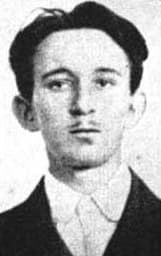
Vaso Čubrilović (Serbian Cyrillic: Васо Чубриловић; 14 January 1897 – 11 June 1990) was a Yugoslav and Bosnian Serb scholar and politician. As a teenager, he joined the South Slav student movement known as Young Bosnia and was involved in the conspiracy to assassinate Archduke Franz Ferdinand of Austria on 28 June 1914. His brother Veljko was also involved in the plot. Čubrilović was convicted of treason by the Austro-Hungarian authorities and given a sixteen-year sentence; his brother was sentenced to death and executed. Čubrilović was released from prison at war's end and studied history at
Vaso Čubrilović (Serbian Cyrillic: Васо Чубриловић; 14 January 1897 – 11 June 1990) was a Yugoslav and Bosnian Serb scholar and politician. As a teenager, he joined the South Slav student movement known as Young Bosnia and was involved in the conspiracy to assassinate Archduke Franz Ferdinand of Austria on 28 June 1914. His brother Veljko was also involved in the plot. Čubrilović was convicted of treason by the Austro-Hungarian authorities and given a sixteen-year sentence; his brother was sentenced to death and executed. Čubrilović was released from prison at war's end and studied history at the universities of Zagreb and Belgrade. In 1937, he delivered a lecture to the Serbian Cultural Club in which he advocated for the expulsion of the Albanians from Yugoslavia. Two years later, he became a history professor at the University of Belgrade. Following the Axis invasion of Yugoslavia in April 1941, Čubrilović was arrested by the Germans and sent to the Banjica concentration camp, where he remained imprisoned for much of the war. As World War II drew to a close, Čubrilović urged the Yugoslav authorities to expel ethnic minorities (particularly Germans and Hungarians) from the country. At war's end, he became a government…
0 comentarii0 reacții
Vaso Čubrilovića adăugat o fotografie
acum 3 luni
R.I.P Vaso
Early life Vaso Čubrilović was born in Bosanska Gradiška on 14 January 1897. His was a well known family from the region of Bosanska Krajina. He was a relative of Vaso Vidović, a leader of the 1875–77 Herzegovina Uprising who attended the Congress of Berlin. Čubrilović finished primary school in his hometown. He went on to attend the Tuzla Gymnasium but was expelled for refusing to stand during the Austro-Hungarian national anthem. He subsequently enrolled in the sixth class of the First Sarajevo Gymnasium. Assassination of Archduke Franz Ferdinand and World War I Čubrilović had been a member of Young Bosnia prior to the outbreak of World War I. He and his older brother were involved in the conspiracy to assassinate of Archduke Franz Ferdinand on 28 June 1914. The younger Čubrilović was the youngest of the conspirators. He was arrested by the Austro-Hungarian authorities in Bosanska Dubica on 3 July. The main conspirators were tried in a military prison in Sarajevo. The state attorney charged twenty-two of the accused with high treason and murder and three with complicity to commit murder. The trial began on 12 October and lasted until 23 October. Čubrilović was only 17 years and six…
0 comentarii0 reacții
Vaso Čubrilovića adăugat o fotografie
acum 3 luni
R.I.P Vaso
Interwar period At a time when Germany can expel tens of thousands of Jews and Russia can shift millions of people from one part of the continent to another, the evacuation of a few hundred thousand Albanians will not set off a world war. Be this as it may, decision-makers should know ahead of time what they want and unfalteringly pursue those goals, regardless of possible international repercussions. Čubrilović completed his high school education in Sarajevo in 1919. First, he enrolled at the University of Zagreb to study history, but later transferred to the University of Belgrade, where he received a Bachelor's degree in history in 1922. In 1929, he obtained his Ph.D. at the University of Belgrade with a thesis titled "The Bosnian Uprising 1875–1878". In the meantime, he had worked as a history teacher at high schools in Sremska Mitrovica, Sarajevo and Belgrade. The historian Vladimir Ćorović subsequently selected Čubrilović as his personal assistant. In 1934, Čubrilović became a docent at the university. From 1921 to 1939, he was an active member of the Agrarian Party. In 1937, Čubrilović delivered a lecture to the Serbian Cultural Club in which he outlined possible methods the Yugoslav government could use…
0 comentarii0 reacții
Vaso Čubrilovića adăugat o fotografie
acum 3 luni
R.I.P Vaso
World War II and later life In 1939, Čubrilović became a professor at the University of Belgrade. In April 1941, the Axis powers invaded Yugoslavia, and Čubrilović was arrested by the Gestapo in the coastal town of Risan. From there, he was transferred to Belgrade and imprisoned at the Banjica concentration camp, where he spent much of the war. Once German forces had been forced out of Serbia, Čubrilović became an advisor to Yugoslavia's new communist leader, Josip Broz Tito. The anti-Serb pogroms of World War II, particularly those orchestrated by the Albanians, again directed Čubrilović's attention to the status of Yugoslavia's national minorities. On 17 November 1944, in Belgrade, Čubrilović presented a memorandum titled "The Minority Problem in the New Yugoslavia" (Serbo-Croatian: Manjinski problem u novoj Jugoslaviji) to the communist authorities. In it, he advised Tito's government to expel all of Yugoslavia's Germans, Hungarians, Italians, Romanians and Albanians. Indeed, virtually all ethnic Germans living in the country were forced out, as were many Hungarians and Romanians. "The minority problem," Čubrilović wrote, "if we don't solve it now, will never be solved." At the time, such suggestions did not come across as particularly radical given that they coincided with the…
0 comentarii0 reacții
Vaso Čubrilovića adăugat o fotografie
acum 3 luni
R.I.P Vaso
Works
"Bosanski Frajkori u Austro-turskom ratu 1788—1791", Belgrade, 1933.COBISS 516370583
"Politički uzroci seoba na Balkanu", Belgrade, 1930.
"Poreklo muslimanskog plemstva u Bosni i Hercegovini", Belgrade, 1935.
"Oko proučavanja srednjovenkovnog feudalizma: Povodom dela Georgija Ostrogorskog", 1952.
"Terminologija plemenskog društva u Crnoj Gori", Belgrade, 1959.
"Srpska pravoslavna crkva pod Turcima od XV do XIX veka", Belgrade, 1960.
"Postanak plemena Kuča", Belgrade, 1963.
"Malonšići, pleme u Crnoj Gori", Belgrade, 1964.
"Bosansko Podrinje i Prvi srpski ustanak", collection of works honoring Filip Višnjić and epic poetry, Belgrade, 1936.
"Istorijska osnova Višnjićevoj pesmi "Boj na Mišaru", Belgrade, 1938.
"Prvi srpski ustanak i bosanski Srbi", Belgrade, 1939.
"Prvi srpski ustanak", Belgrade, 1954.
"U čemu je suština i kakva je istorijska i kulturna uloga Prvog srpskog ustanka 1804. godine", Belgrade, 1963.
"Uloga narodnih masa i ličnosti u srpskoj revoluciji", Belgrade, 1983.
0 comentarii0 reacții
Vaso Čubrilovića lăsat un gând
acum 3 luni
Bosanski ustanak 1875—1878
"Srbija 1858–1903", with Vladimirom Ćorovićem, Belgrade, 1938.
"Istorija političke misli u Srbiji 19. veka", Belgrade, 1958.
"Istorijski osnovi o postanku Jugoslavije 1918.", Zagreb, 1969.
"Odnos Srbije i Austrije u 19. veku. Velike sile i Srbija pred Prvi svetski rat", Belgrade, 1976.
"Istočna kriza 1875–1878. godine i njen značaj na međunarodne odnose koncem 19. i početkom 20. veka", Sarajevo, 1977.
"Berlinski kongres u svetlu savremene istorijske nauke", Politika, Belgrade, 1978.
"Spoljni i unutrašnji faktori u stvaranju i razvitku Jugoslavije u 20. veku", Belgrade, 1989.
"Politička prošlost Hrvata", Belgrade, 1939.
"Vasa Pelagić", Sarajevo, 1924.
"Manjinski problem u novoj Jugoslaviji", Belgrade, 1944.
"Zašto sam protiv - Akademik Vasa Čubrilović o Memorandumu SANU", interview published in NIN, Belgrade, 1986.
"Odabrani istorijski radovi", Belgrade, 1983.
"Istorije Beograda", a history of Belgrade in three volumes, one of the co-authors, 1974.
"Jovan Cvijić i stvaranje Jugoslavije", a study
"Život i rad Jovana Cvijića", biography of Jovan Cvijić, 1987.