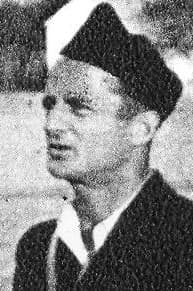
Vicko Krstulović (27 April 1905 – 28 September 1988) was a Croatian Yugoslav communist revolutionary, the most prominent Partisan military commander from Dalmatia during World War II, and a post-war communist politician. He was an illegal communist activist during the 1920s and 1930s in Split at a time when communist sympathizers were brutally persecuted by the Yugoslav monarchy. As an officer in the Partisans during World War II, he was in charge of creating and organising the resistance movement in Dalmatia. In Communist Yugoslavia, he worked in various government offices and was remembered
Vicko Krstulović (27 April 1905 – 28 September 1988) was a Croatian Yugoslav communist revolutionary, the most prominent Partisan military commander from Dalmatia during World War II, and a post-war communist politician. He was an illegal communist activist during the 1920s and 1930s in Split at a time when communist sympathizers were brutally persecuted by the Yugoslav monarchy. As an officer in the Partisans during World War II, he was in charge of creating and organising the resistance movement in Dalmatia. In Communist Yugoslavia, he worked in various government offices and was remembered for his work and contribution to his native Split.
0 comentarii0 reacții
Vicko Krstulovića adăugat o fotografie
acum 3 luni
R.I.P Vicko
Early years (1905–1918)
Vicko Krstulović was born on 27 April 1905 in Split during the former Austria-Hungary empire. He was born to a labour family. His father worked in the Split fields as an agriculturist. Vicko was introduced in politics thanks to his father who was a social democrat. His father was the first person to carry the red flag during the Labour Day parade in Split.
When his father was mobilised for World War I, Vicko was forced to carry on his work in the fields. His father returned from the war with an illness which prevented him from doing hard work. At that time, Vicko would hide people in his fields that escaped mobilisation for the war. Vicko like most Split residents supported the Kingdom of Serbia and was a fierce opponent of the Austria-Hungary empire which ruled Dalmatia with repression.
0 comentarii0 reacții
Vicko Krstulovića adăugat o fotografie
acum 3 luni
R.I.P Vicko
Illegal political activism (1919–1937) After the war, Vicko expected much from the newly formed Kingdom of Serbs, Croats and Slovenes but it proved to be a disaster. In 1919, the Communist Party of Yugoslavia was founded and Vicko was attracted by its ideas. In 1920, after the Communists won a large number of the cities in the local elections, the government banned them from acting legally and they became a forbidden party. At that time in 1920, Vicko became a member of the League of Communist Youth of Yugoslavia. He worked as an illegal and was obligated to spread forbidden communist material around the city (mostly books). In 1922, he officially joined the Communist Party of Yugoslavia. He became a member of the Dalmatian communist committee where he helped organise secret meetings, welcome foreign communist activists to the city and hide them. He also helped in organising Trade unions. In the 1930s, his house was under raid by the police, and he was arrested for dispatching illegal material. He was tortured and sentenced to prison. During that time, his mother died from illness after which he swore on her grave that he will avenge her. Secretary of the Provincial committee…
0 comentarii0 reacții
Vicko Krstulovića adăugat o fotografie
acum 3 luni
R.I.P Vicko
Organising the first partisan detachments (1941) After Yugoslavia lost the war, the Dalmatian coast along with Split was occupied by the Italian army. On 10 April 1941, the German puppet state and Italian protectorate called Independent State of Croatia (NDH) was established in Zagreb. Soon after, Vicko Krstulović went to Zagreb for a meeting where the communist party planned an armed resistance. Since Vicko was the Dalmatian committee secretary, he was obligated to prepare and lead the resistance in Dalmatia. He was given only a few months to prepare. Vicko expressed his concerns. He believed that it was impossible to prepare in such a low amount of time, but he was forced to do so. In August 1941, a few partisan detachments were sent from Dalmatian cities with the most notable one being the 1st Split Partisan Detachment which was made of 44 fighters. They went from Split to the Dalmatian hinterlands. Their goal was to reach the Dinara mountains and connect with the resistance movement in Bosnia. The detachment was quickly spotted by the Ustaše militia and Italian army and engaged in combat. After a few hours of fighting, they were outnumbered by the Italian and Ustaše forces and…
0 comentarii0 reacții
Vicko Krstulovića lăsat un gând
acum 3 luni
Battle for the Wounded (February–April 1943) In the beginning of 1943, the Germans launched the Fourth Enemy Offensive. Their goal was to surround and destroy the partisan forces in western Bosnia and in other parts of Independent State of Croatia. Josip Broz Tito along with the Supreme HQ decided to evacuate the entire area and cross the Neretva river. They were meant to reach Montenegro. Vicko Krstulović and the 9th Dalmatian division were given a hard task to protect the flanks facing Jablanica and Neretva from the difficult and craggy terrain of Imotski and Biokovo. The division faced heavy attacks from the Germans, Italians, Ustashe and Chetniks. The enemy used heavy aviation, tanks and artillery which gradually forced all 3 partisan brigades to slowly retreat to the right shore of the Neretva River. While the 9th division was under critical pressure from the enemy and forced to stay in the hills above Neretva, they were still obligated by the orders of Tito and the HQ to take and move the Central hospital and heavy wounded through the mountain terrain of Dinara, Bikovo, Kamešnica and Dalmatia. Vicko refused to accept those orders because he knew they were impossible and suicidal. After…
0 comentarii0 reacții
Vicko Krstulovića lăsat un gând
acum 3 luni
Battle of the Sutjeska (May–June 1943) After the 9th division was disbanded, Vicko joined the Supreme HQ and Tito. The entire Yugoslav liberation army was heading to cross the Sutjeska river. The Axis rallied 127,000 land troops and 300 aeroplanes for the Fifth Enemy Offensive. Their goal was to eliminate Tito and central partisan forces. Vicko and the Supreme HQ went through the Durmitor massive between the Tara and Piva rivers in the mountainous areas of northern Montenegro. Vicko travelled with his family and with the famous poet Vladimir Nazor. They faced heavy fog and slippery terrain in the mountains. The area was Chetnik controlled, and food supply was extremely low. In the early morning, they managed to cross the Sutjeska river under heavy rain and German mortar shelling. When the weather cleared that day, German aviation started advancing. The partisans and HQ quickly advanced between Gornje and Donje Bare to the Hrčavka river. They were under German fire and Vicko almost lost his entire family. Tito was also wounded from an aviation bomb. The Supreme HQ managed to reach Miljevina. They settled there and were almost liquidated by a German task force, but the partisans managed to react first…
0 comentarii0 reacții
Vicko Krstulovića lăsat un gând
acum 3 luni
Political functions in Federal Yugoslavia In December 1944, Vicko was made the commissioner for industry and trade of ZAVNOH. He stayed in Split during the first few months of liberation. In April 1945, he became the minister of internal affairs of the newly established Federal State of Croatia. He moved to Zagreb after the Ustashe government fled from it in May 1945. In January 1946, he became the minister of labour and maritime affairs in the Federal Executive Council of Yugoslavia. He then moved to Belgrade with his family. In April 1951, he became the president of the regional committee of the Communist Party of Croatia for Dalmatia and in February 1952, he became the President of the Presidency of the Croatian Parliament which was at the time the equivalent position in the People's Republic of Croatia to a head of state in other countries. After his term ended, he became the member of the Federal Executive Council in February 1953. From 1954 to 1958, he was the committee president in the Croatian Parliament and a representative in the parliament from 1945 to 1963. From 1963 to 1967, he was the president of the budget committee in the Federal Assembly…
0 comentarii0 reacții
Vicko Krstulovića lăsat un gând
acum 3 luni
Final years
Vicko spent his last years of life in his native Split. He was still active in social life and he still gave interviews to journalists. In September 1988, he was admitted to the Military hospital in Split for treatment but during a routine therapy session, the doctors used electrical equipment not knowing he had a pacemaker. On 28 September 1988, Vicko Krstulović died due to medical complications.
After his death, his son Vladimir Krstulović gave all of Vicko's possessions and archives to the Historical museum in Belgrade.
0 comentarii0 reacții
Vicko Krstulovića lăsat un gând
acum 3 luni
Private life
Vicko was married to Lucija Krstulović and had 4 children: Maksim, Nataša, Viborg and Vladimir. His wife and 3 children, Maksim, Nataša and toddler Viborg were with him during the Battle of Neretva and Sutjeska. During the long marches between those battles, his son Maksim fell off a horse and injured his arm which would leave permanent damage. His daughter Nataša suffered from typhoid fever at Neretva and almost died during the crossing of the river. His fourth and youngest son Vladimir was born after the war.
Maksim Krstulović became a painter and critical intellectual who wrote articles that were more to the left than the Yugoslav politics was at the time. He caused controversy and in 1974, he was killed at his apartment in London. The killer was never caught but some suspect that it was done by the Yugoslav State Security Administration.
His youngest son Vladimir Krstulović was responsible for the publishing of Vicko's memoirs in 2012.