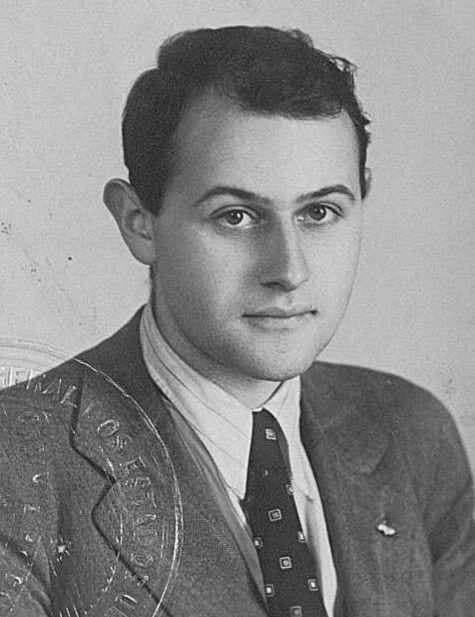
Vilém Flusser (May 12, 1920 – November 27, 1991) was a Czech-born Brazilian philosopher, writer and journalist, best known for his contributions to media studies, communication theory, and the philosophy of language. He lived for a long period in São Paulo (where he became a Brazilian citizen) and later in France, and his works are written in many different languages. His early work was marked by discussion of the thought of Martin Heidegger, and by the influence of existentialism and phenomenology. Phenomenology would play a major role in the transition to the later phase of his work, in whic
Vilém Flusser (May 12, 1920 – November 27, 1991) was a Czech-born Brazilian philosopher, writer and journalist, best known for his contributions to media studies, communication theory, and the philosophy of language. He lived for a long period in São Paulo (where he became a Brazilian citizen) and later in France, and his works are written in many different languages.
His early work was marked by discussion of the thought of Martin Heidegger, and by the influence of existentialism and phenomenology. Phenomenology would play a major role in the transition to the later phase of his work, in which he turned his attention to the philosophy of communication and of artistic production. He contributed to the dichotomy logic theory through history: the period of image worship, and period of text worship, with deviations consequently into idolatry and "textolatry".
0 comentarii0 reacții
Vilém Flussera adăugat o fotografie
acum 3 luni
R.I.P Vilém
Life Flusser was born in 1920 in Prague, Czechoslovakia into a family of Jewish intellectuals. His father, Gustav Flusser, studied mathematics and physics (under Albert Einstein among others). Vilém attended German and Czech primary schools and later a German grammar school. In 1938, Flusser started to study philosophy at the Juridical Faculty of the Charles University in Prague. In 1939, shortly after the Nazi occupation, Flusser emigrated to London (with Edith Barth, his later wife, and her parents) to continue his studies for one term at the London School of Economics and Political Science. Vilém Flusser lost all of his family in the German concentration camps: his father died in Buchenwald in 1940; his grandparents, his mother and his sister were brought to Theresienstadt and later to Auschwitz where they were killed. The next year, he emigrated to Brazil, living both in São Paulo and Rio de Janeiro. He started working at a Czech import/export company and then at Stabivolt, a manufacturer of radios and transistors. In 1960 he started to collaborate with the Brazilian Institute of Philosophy (IBF) in São Paulo and published in the Revista Brasileira de Filosofia; by these means he seriously approached the Brazilian intellectual community.…
0 comentarii0 reacții
Vilém Flussera lăsat un gând
acum 3 luni
Philosophy Flusser's essays are short, provocative and lucid, with a resemblance to the style of journalistic articles. Critics have noted he is less a 'systematic' thinker than a 'dialogic' one, purposefully eclectic and provocative (Cubitt 2004). However, his early books, written in the 1960s, primarily in Portuguese, and published in Brazil, have a slightly different style. Flusser's writings relate to each other, however, which means that he intensively works over certain topics and dissects them into a number of brief essays. His main topics of interest were: epistemology, ethics, aesthetics, ontology, language philosophy, semiotics, philosophy of science, the history of Western culture, the philosophy of religion, the history of symbolic language, technology, writing, the technical image, photography, migration, media and literature, and, especially in his later years, the philosophy of communication and of artistic production. His writings reflect his wandering life: although the majority of his work was written in German and Portuguese, he also wrote in English and French, with scarce translation to other languages. Because Flusser's writings in different languages are dispersed in the form of books, articles or sections of books, his work as a media philosopher and cultural theorist is only now becoming more widely known.…
0 comentarii0 reacții
Vilém Flussera lăsat un gând
acum 3 luni
Philosophy of photography Writing about photography in the 1970s and 80s, in the face of the early worldwide impact of computer technologies, Flusser argued that the photograph was the first in a number of technical image forms to have fundamentally changed the way in which the world is seen. Historically, the importance of photography had been that it introduced nothing less than a new epoch: 'The invention of photography constitutes a break in history that can only be understood in comparison to that other historical break constituted by the invention of linear writing.' Whereas ideas might previously have been interpreted in terms of their written form, photography heralded new forms of perceptual experience and knowledge. As Flusser Archive Supervisor Claudia Becker describes, "For Flusser, photography is not only a reproductive imaging technology, it is a dominant cultural technique through which reality is constituted and understood". In this context, Flusser argued that photographs have to be understood in strict separation from 'pre-technical image forms'. For example, he contrasted them to paintings which he described as images that can be sensibly 'decoded', because the viewer is able to interpret what he or she sees as more or less direct signs of what…
0 comentarii0 reacții
Vilém Flussera lăsat un gând
acum 3 luni
Concept of Home and Homelessness Flusser was deeply influenced by the loss of his native Prague, and his relocations throughout his life which can be seen in his writings and causing him to proclaim his homelessness, "because there are so many homelands that make their home in me". His personal biography was particularly helpful for his studies in interpersonal communication and how to facilitate it. Communication, which are the gaps between different positions, is part of a cultural phenomenon relying on unconsciously learnt patterns at home. Language therein is a major influence on one's thinking. Flusser asked what are the consequences of the loss of one's home and traditional connections? He differentiated between the two meanings of home originating in the German language, "Heimat" understood as a homeland and "Wohnung" understood as in house, and argued that home cannot be understood as an eternal value transcending time and space. A person is bound to its "Heimat" through invisible threads such as connections to people, tradition and language, which all lay beyond the consciousness. Only when a person is removed from their home they become aware of the ties which reveal themselves as unconscious judgements. These unconscious "habits prevent bits of…
0 comentarii0 reacții
Vilém Flussera lăsat un gând
acum 3 luni
Monographs Angenommen. Eine Szenenfolge, Göttingen: Immatrix, 1989. What If? Twenty-Two Scenarios in Search of Images, trans. Anke Finger and Kenneth Kronenberg, University of Minnesota Press, 2022. Das XX. Jahrhundert. Versuch einer subjektiven Synthese, 1950s, c200 pp. Unpublished. (in German) [1] Língua e realidade, São Paulo: Herder, 1963, 238 pp; São Paulo: Annablume, 2004; 2009, 232 pp. (in Portuguese) Jazyk a skutečnost, trans Karel Palek, Triáda, 2005, 200 pp. Introduction. (in Czech) Language and Reality, trans Rodrigo Maltez Novaes, Univ Of Minnesota Press, 2018, 220pp. (in English) A história do diabo, São Paulo: Martins, 1965, 216 pp; São Paulo: Annablume, 2010. (in Portuguese) Die Geschichte des Teufels, ed. Andreas Müller-Pohle, Göttingen: European Photography, 1993; 2nd ed., 1996, 200 pp. (in German) Příběh ďábla, trans. Jiří Fiala, Galerie Gema, 1997, 185 pp. (in Czech) [2] The History of the Devil, trans. Rodrigo Maltez Novaes, Univocal, 2014, 220 pp. Da religiosidade: a literatura e o senso de realidade, São Paulo: Conselho estadual de cultura, 1967, 147 pp; São Paulo: Escrituras, 2002. (in Portuguese) La force du quotidien, trans. Jean Mesrie and Barbara Niceall, Paris: Mame, 1973, 146 pp; 1989. Preface by Abraham Moles. (in French). Review. Le monde codifié, Conférence du 3 Mai…
0 comentarii0 reacții
Vilém Flussera lăsat un gând
acum 3 luni
Taipei: Yuan-Liou, 1994. (in Chinese) Pour une philosophie de la photographie, Paris: Circé, 1996. (in French) Ensaio sobre a fotografia: para uma filosofia da técnica, Lisbon: Relógio d'Água, 1998. (in Portuguese) Thessaloniki: University Studio Press, 1998. (in Greek) 사진의 철학을 위하여, Seoul: Communication Books, 1999. (in Korean) Za filozofiju fotografije, trans. Tijana Tubić, Belgrade: Kulturni Centar Beograda, 1999; 2005, 80 pp. (in Serbian) Towards A Philosophy of Photography, trans. Anthony Mathews, London: Reaktion Books, 2000. Una filosofía de la fotografía, Madrid: Síntesis, 2001, 192 pp. (in Spanish) [7] Archived October 11, 2014, at the Wayback Machine Za edna filosofia na fotografiata, Plovdiv: Horizonti, 2002. (in Bulgarian) Pentru o filosofie a fotografie, Bucharest: Idea Design & Print, 2003. (in Romanian) Za edna filosofia na fotografira, Moscow, 2002. (in Russian) Ku filozofii fotografii, trans. Jacek Maniecki, Katowice: Akademia Sztuk Pięknych w Katowicach, 2004; Warszawa: Wydawnictwo Aletheia, 2015. (in Polish) Filozofija Fotografije, Zagreb: Scarabeus, 2007. (in Croatian) Een filosofie van de fotografie, Utrecht: Uitgeverij Ijzer, 2007. (in Dutch) Za filosofiyu fotografii [За философию фотографии], trans. G. Khaydarova, St. Petersburg: St. Petersburg State University, 2008, 146 pp. (in Russian) K filozofiji fotografije, Ljubljana: ZSKZ, 2010. (in Slovenian) Ins Universum der technischen Bilder, Göttingen: European…
0 comentarii0 reacții
Vilém Flussera lăsat un gând
acum 3 luni
Groundless, Metaflux, 2017. (in English)
A Dúvida, Rio de Janeiro: Relume Dumará, 1999; São Paulo: Anna Blume, 2011 (In Portuguese)
On Doubt, Trans. Rodrigo Maltez Novaes, Minneapolis: Univocal, 2014 Foreword by Rainer Guldin 100pp. (in English)
O Último Juízo: Gerações Vols. 1 & 2, São Paulo: É Realizações, 2017 (in Portuguese)
0 comentarii0 reacții
Vilém Flussera lăsat un gând
acum 3 luni
Book chapters, papers, articles (selection) "Filosofia da linguagem", Ita-Humanidades 2 (1966), pp 133–210. (in Portuguese) "Auf der Suche nach Bedeutung" Archived September 14, 2015, at the Wayback Machine, trans. Edith Flusser with Vera Schwamborn, Tendenzen der aktuellen Philosophie in Brasilien in Selbstbildnissen 27 (1975), São Paulo: Loyola. (in German). Autobiographical essay, written in English and Portuguese in October–November 1969 in São Paulo. See also Bodenlos, 1999. "Em busca do significado", in Stanislaus Ladusãns, Rumos da filosofia atual no Brasil em auto-retratos, São Paulo: Loyola, 1976, pp 493–506. (in Portuguese) "In Search of Meaning (Philosophical Self-portrait)", in Writings, 2002, pp 197–208. "The Photograph as Post-Industrial Object: An Essay on the Ontological Standing of Photographs", Leonardo 19:4 (1986), pp 329–332. "Fernsehbild und politische Sphäre im Lichte der rumänischen Revolution", trans. Almuth Carstens, in Von der Bürokratie zur Telekratie. Rumänien im Fernsehen, ed. Peter Weibel, Berlin: Merve Verlag, 1990, pp 103–114. (in German) "On Memory (Electronic or Otherwise)", Leonardo 23:4 (1990), pp 397–399. Adapted from a presentation at Ars Electronica, September 14, 1988. "Die Stadt als Wellental in der Bilderflut", in Nachgeschichten, 1990. Written in 1988. Repr. in Arch+ 111 (March 1992), pp 58–63 [8]; Die Revolutionen der Bilder, 1995; Medienkultur, 1997, pp…