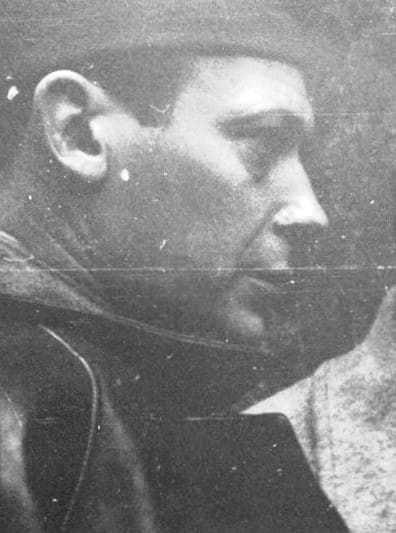
Vladimir "Vlatko" Velebit, PhD (19 August 1907 – 29 August 2004) was a Yugoslav politician, diplomat and military leader who rose the rank of Major-General during World War II. A lawyer by profession, after the war he became a diplomat and historian. Among his notable post-World War II appointments were the Yugoslav Ambassador to Rome as well as the Court of St. James's and World Bank. Additionally, he was Yugoslav Deputy Minister of Foreign Trade, and UNECE Executive Secretary from 1960 to 1967.
Vladimir "Vlatko" Velebit, PhD (19 August 1907 – 29 August 2004) was a Yugoslav politician, diplomat and military leader who rose the rank of Major-General during World War II. A lawyer by profession, after the war he became a diplomat and historian.
Among his notable post-World War II appointments were the Yugoslav Ambassador to Rome as well as the Court of St. James's and World Bank. Additionally, he was Yugoslav Deputy Minister of Foreign Trade, and UNECE Executive Secretary from 1960 to 1967.
0 comentarii0 reacții
Vladimir Velebita adăugat o fotografie
acum 3 luni
R.I.P Vladimir
Early life and education Born in Zadar, Austria-Hungary to Serbian father Ljubomir Velebit and Slovenian-Croatian mother Olga Šeme, Vladimir's family had a long military tradition. His father Ljubomir was an officer in the Austro-Hungarian Army, fighting on the Russian front during World War I and later becoming brigadier-general in the Royal Yugoslav Army, while Vladimir's paternal grandfather Dušan Velebit was a general in the Austrian Army who married Elisabeth Marno von Eichenhorst, daughter of another Austrian general Adolf Marno von Eichenhorst. Even Vladimir's great grandfather Ilija Velebit was an officer in the Austrian army. His male ancestors were Serbs originating from the village of Gornja Pastuša near Petrinja in the Banija region that was part of the Austrian-created Military Frontier. They were recruited into the Austrian army, eventually achieving high ranks. Velebit began his formal education in Timișoara in German language. His family left the city just after the outbreak of World War I and went to Trieste while his father was off in Russia fighting for the Austro-Hungarians. Young Vladimir was soon moved again, this time to Vienna where he got enrolled in a private school that held classes in French language. Following the end of the war in…
0 comentarii0 reacții
Vladimir Velebita lăsat un gând
acum 3 luni
World War II Following April 1941 Nazi invasion and dismemberment of the Yugoslav Kingdom, Velebit stayed in Zagreb that became capital of the newly created Nazi client, Ustaše-run puppet state entity Independent State of Croatia (NDH). He operated as an underground collaborator of the KPJ-established People's Liberation Front. While working underground he used the alias name Vladimir Petrović, although due to being a well known and respected lawyer before the war he experienced no trouble with NDH authorities. During March 1942 Velebit left Zagreb and joined the Partisans who mounted a guerrilla resistance to the Nazis and domestic collaborationists. Right away Tito included him in the army's Supreme Command where he mostly worked on establishing some sort of military court authority. Due to his education and knowledge of foreign languages, along with Koča Popović and Milovan Đilas, Velebit was part of the Partisan delegation in Gornji Vakuf and Zagreb at the controversial March 1943 German-Partisan negotiations while the Battle of Neretva raged several hundred kilometers to the south. Velebit and Đilas conducted the negotiations under pseudonyms Vladimir Petrović and Miloš Marković, respectively, while Koča Popović gave his real name. In June 1943, Velebit became the point of contact for foreign…
0 comentarii0 reacții
Vladimir Velebita lăsat un gând
acum 3 luni
Post-war diplomatic career Right after the end of World War II Velebit continued his diplomatic activity. In the Democratic Federal Yugoslavia's provisionary government that got formed on the basis of British-brokered Treaty of Vis and later the Belgrade Agreement, he was the deputy to the Foreign Affairs Minister. He then became one of the chief members of the secret Yugoslav diplomatic mission to Washington, negotiating the terms and scope of the American help to Yugoslavia. After returning home to the country that was in the meantime re-constituted as a Stalinist communist state called Federal People's Republic of Yugoslavia, he became deputy to Foreign Affairs Minister Stanoje Simić. In that role, Velebit negotiated with the Allies during the Trieste Crisis. In March 1948, after Soviet accusation that he was a British spy, Velebit was forced into resigning his post at the Yugoslav Foreign Affairs Ministry and got moved to the Tourist and Service Industry Committee. During the 1948 Cominform resolution and the fallout of subsequent Tito–Stalin split, Velebit was on more than one occasion cited by the Soviets as a spy who works for the British. In 1951, Velebit became Yugoslav ambassador to Italy, while a year later he got the…
0 comentarii0 reacții
Vladimir Velebita lăsat un gând
acum 3 luni
Personal
Velebit married Vera Becić, a woman of Croatian ethnicity, the daughter of Croatian painter Vladimir Becić. They had two sons: Vladimir Jr. and Dušan.