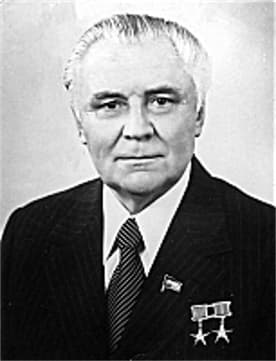
Volodymyr Vasyliovych Shcherbytsky (17 February 1918 – 16 February 1990) was a Ukrainian Soviet politician who served as First Secretary of the Ukrainian Communist Party from 1972 to 1989. A close ally of Soviet leader Leonid Brezhnev, Shcherbytsky replaced the reformist leader, Petro Shelest, in 1972 as part of a crackdown on the Ukrainian intelligentsia. Under Shcherbytsky's neo-Stalinist rule, Ukraine was subjected to an intensive Russification campaign as well as a rapid shift to nuclear power, which ultimately resulted in the 1986 Chernobyl disaster. In 1989, Shcherbytsky was removed amid
Volodymyr Vasyliovych Shcherbytsky (17 February 1918 – 16 February 1990) was a Ukrainian Soviet politician who served as First Secretary of the Ukrainian Communist Party from 1972 to 1989. A close ally of Soviet leader Leonid Brezhnev, Shcherbytsky replaced the reformist leader, Petro Shelest, in 1972 as part of a crackdown on the Ukrainian intelligentsia. Under Shcherbytsky's neo-Stalinist rule, Ukraine was subjected to an intensive Russification campaign as well as a rapid shift to nuclear power, which ultimately resulted in the 1986 Chernobyl disaster. In 1989, Shcherbytsky was removed amidst widespread protests against his rule, and died months later.
0 comentarii0 reacții
Volodymyr Scherbytskya adăugat o fotografie
acum 3 luni
R.I.P Volodymyr
Early life
Shcherbytsky was born in Verkhnodniprovsk on 17 February 1918 to Vasily Grigorievich Shcherbytsky (1890–1949) and Tatyana Ivanovna Shcherbitskaya (1898–1990), just two weeks after the Soviet takeover of the city during the Ukrainian–Soviet War. During his school years, he worked as an activist and a member of the Komsomol from 1931. In 1934, while still in school, he became an instructor and agitator for the district committee of the Komsomol. In 1936, he entered the Faculty of Mechanics at the Dnipropetrovsk Chemical Technology Institute. During his training, he worked as a draftsman, designer and compressor driver at the factories in Dnipropetrovsk. Shcherbytsky graduated from the Dnipropetrovsk Chemical Technology Institute in 1941 and in the same year became a member of the Communist Party of the Soviet Union.
0 comentarii0 reacții
Volodymyr Scherbytskya adăugat o fotografie
acum 3 luni
R.I.P Volodymyr
Military career Following the German invasion of the Soviet Union in June 1941, Shcherbytsky was mobilized into the ranks of the Red Army. Because he was a graduate with a major in chemical equipment and machinery, he was sent to attend short term courses at the Military Academy of Chemical Protection named after Voroshilov, which was evacuated from Moscow to Samarkand in Uzbek SSR. After graduation, Shcherbytsky was appointed head of the chemical unit within the 34th Infantry Regiment of the 473rd Infantry Division in the Transcaucasian Front. In November 1941, the division was formed in the cities of Baku and Sumgayit in Azerbaijan SSR. On 8 January 1942, the division was renamed as 75th Rifle Division, and in April of the same year, Shcherbytsky and the division took part in the Anglo-Soviet invasion of Iran. On the same year, he served in a tank brigade. In March 1943, Shcherbytsky was transferred to the chemical department at the headquarters of the Transcaucasian Front, where he served until the end of the war. In August 1945, the Transcaucasian Front was reorganized into the Tbilisi Military District and Shcherbytsky's last military assignment was as an assistant chief of the chemistry department of…
0 comentarii0 reacții
Volodymyr Scherbytskya adăugat o fotografie
acum 3 luni
R.I.P Volodymyr
Political career After World War II, he worked as an engineer in Dniprodzerzhynsk (now Kamianske). From 1948 Shcherbytsky was a party functionary in the Communist Party of the Soviet Union. In 1948, he was appointed Second Secretary of Dniprodzerhynsk city communist party committee, soon after Leonid Brezhnev had taken over the First Secretary of the regional party committee. He succeeded Brezhnev as regional party boss in November 1955. In December 1957, he was appointed a Secretary of the Central Committee of the Communist Party of Ukraine. In February 1961, he was appointed chairman of the Ukrainian Council of Ministers, the second highest post in the republic, but in June 1963, just after Petro Shelest had been appointed First Secretary of the Communist Party of Ukraine, Shcherbytysky was shifted to the lesser job of First Secretary of the Dnipropetrovsk regional party committee. On 16 October 1965, after Brezhnev had risen to the supreme position as General Secretary of the Communist Party of the Soviet Union, Shcherbytsky was restored to his former position at the head of the Ukrainian government. First Secretary of the Communist Party of Ukraine In May 1972, Shelest was recalled from his post as head of the Ukrainian…
0 comentarii0 reacții
Volodymyr Scherbytskya lăsat un gând
acum 3 luni
Russification His rule of the Ukrainian Soviet Socialist Republic was characterized by the expanded policies of re-centralisation and suppression of Soviet dissidents, accompanied by a broad assault on Ukrainian culture and intensification of Russification. During Shcherbytsky's rule mass arrests were carried out that incarcerated any member of the intelligentsia that dared to dissent from official state policies. The expirations of political prisoners' sentences were increasingly followed by re-arrest and new sentences on charges of criminal activity. Incarceration in psychiatric institutions became a new method of political repression. Ukrainian language press, scholarly and cultural organisations which had flourished under Shcherbytsky's predecessor Shelest were repressed by Shcherbytsky. Shcherbytsky also made a point of speaking Russian at official functions while Shelest spoke Ukrainian in public events. In an October 1973 speech to fellow party members Shcherbytsky stated that as an "internationalist" Ukrainians were meant to "express feelings of friendship and brotherhood to all people of our country but first of all against the great Russian people, their culture, their language - the language of the Revolution, of Lenin, the language of international intercourse and unity". Shcherbytsky also claimed that "the worst enemy of the Ukrainian people" is "Ukrainian bourgeois nationalism and also international…
0 comentarii0 reacții
Volodymyr Scherbytskya lăsat un gând
acum 3 luni
Downfall Following Brezhnev's death, he was replaced as General Secretary at first by Yuri Andropov and Konstantin Chernenko before the ascension of Mikhail Gorbachev. In 1985, Shcherbytsky was in San Francisco, United States when he received news about Chernenko's death and that the Politburo was in the process of picking up a successor. By the time he is airborne, he received news about the election of Gorbachev as General Secretary. Gorbachev's liberal rule contrasted heavily with Shcherbytsky's hardline principles, and remaining Brezhnev loyalists either retired from their positions or were removed by Gorbachev. Shcherbytsky's removal was originally planned by Gorbachev, owing to the former's hardline rule. However, he decided to allow him to remain in office for several more years in order to keep the Ukrainian nationalist movement subdued. Shcherbytsky was likewise a strong opponent of Gorbachev, saying in one instance: What fool (durak) invented this word perestroika? Why rebuild the house? Is there anything wrong in the Soviet Union? We are fine! What is there to rebuild? It is necessary to improve, reorganize, but why, if the house is not falling apart, why does it need to be rebuilt? An advocate of increased nuclear power, Shcherbytsky's position was significantly…
0 comentarii0 reacții
Volodymyr Scherbytskya lăsat un gând
acum 3 luni
Death and legacy Shcherbytsky died on 16 February 1990 - one day before his 72nd birthday, which also when he was supposed to testify in the Supreme Soviet of the Ukrainian SSR about the events related to the Chernobyl disaster. Although the official version claims that the cause of death was pneumonia, it was alleged that he had committed suicide by shooting himself with his carbine, "unable to deal not only with the end of his own career but also with the end of the political and social order he had served all his life" and had left a suicide note explaining to his wife how to deal with cash, medals and small arms that were kept in the family home. He was buried at the Baikove Cemetery in Kyiv. In 1994 the first President of Ukraine of independent Ukraine Leonid Kravchuk in interviews stated his views about Shcherbytsky’s positive legacy. In January 2003 Deputy Prime Minister of Ukraine on humanitarian policy Dmytro Tabachnyk signed a (first Yanukovych Government) resolution to celebrate Shcherbytsky’s 85th anniversary with the erection of a monument in Kyiv. Due to Ukrainian decommunization laws a street named after Shcherbytsky in Dnipro (formerly Dnipropetrovsk) was renamed to…
0 comentarii0 reacții
Volodymyr Scherbytskya lăsat un gând
acum 3 luni
Personal life
Shcherbytsky was married to Ariadna Gavrilovna Shcherbitskaya, née Zheromskaya (1923–2015) on 13 November 1945. The couple had two children; son Valery (1946–1991), who died due to alcohol and drug addiction just one year after Shcherbytsky's death, and a daughter Olga (1953–2014), who died at a hospital in Kyiv after a serious and prolonged illness. He also had numerous grand and great-grandchildren. Olga was married to Bulgarian businessman Borislav Dionisiev, who then was a soldier in the Bulgarian People's Army and a Consul General of Bulgaria in Odesa. The couple had a daughter before divorcing on an unknown date.
0 comentarii0 reacții
Volodymyr Scherbytskya lăsat un gând
acum 3 luni
Awards
Volodymyr Shcherbytsky was twice awarded the Hero of Socialist Labour — in 1974 and 1977. During his public service he also received numerous other civil and state awards and recognitions, including the Order of Lenin (in 1958, 1968, 1971, 1973, 1977, 1983 and 1988), the Order of October Revolution (in 1978 and 1982), the Order of the Patriotic War, I class (in 1985), the Medal "For the Defence of the Caucasus" (in 1944) and various medals. He was also awarded the Order of Victorious February by the Government of Czechoslovakia (in 1978).