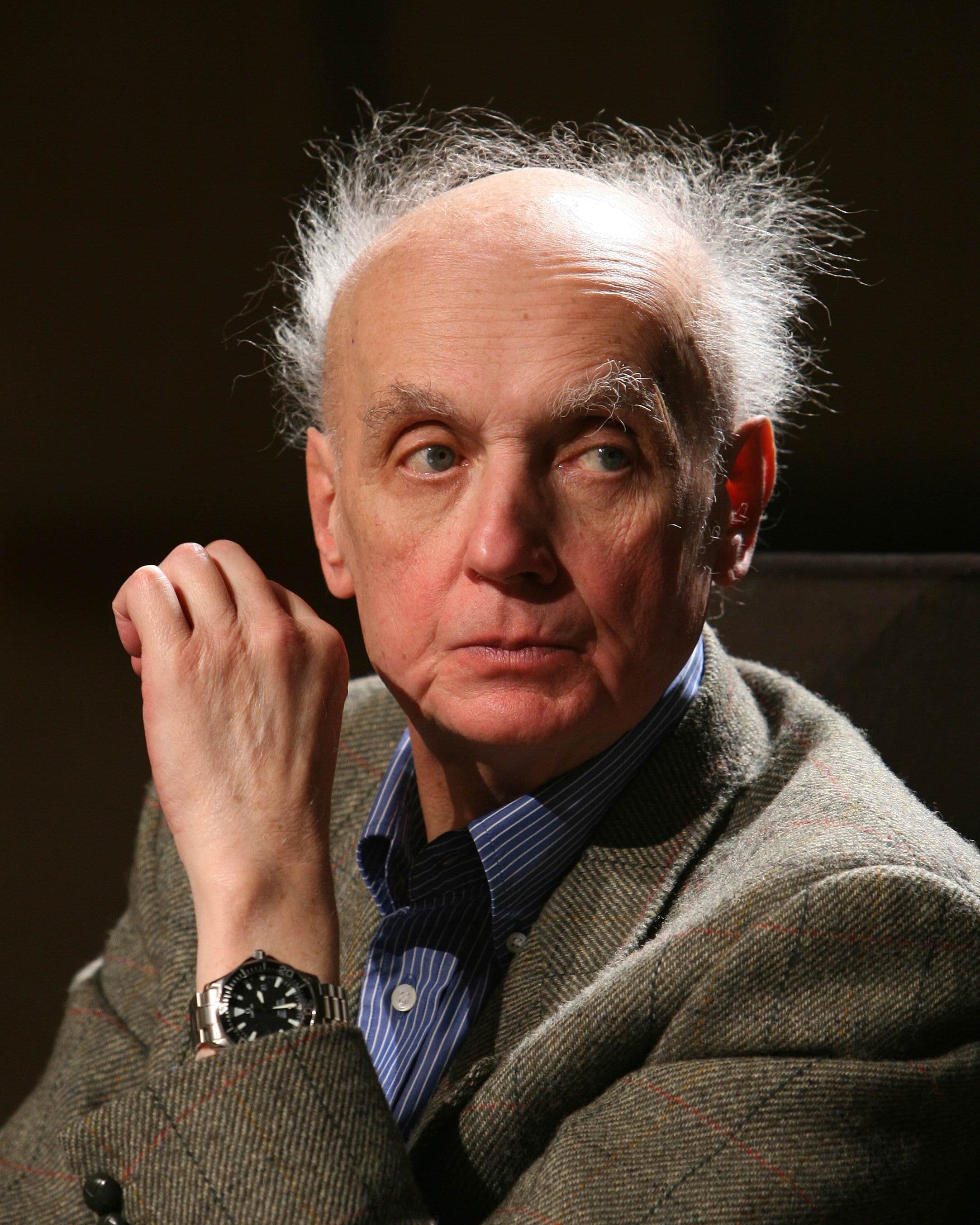
Wojciech Kilar (Polish: [ˈvɔjt͡ɕɛx ˈkʲilar]; 17 July 1932 – 29 December 2013) was a Polish classical and film music composer. One of his greatest successes came with his score to Francis Ford Coppola's Bram Stoker's Dracula in 1992, which received the ASCAP Award and the nomination for the Saturn Award for Best Music. In 2003, he won the César Award for Best Film Music written for The Pianist, for which he also received a BAFTA nomination. In 2012, he became the recipient of Poland's highest distinction, the Order of the White Eagle.
Wojciech Kilar (Polish: [ˈvɔjt͡ɕɛx ˈkʲilar]; 17 July 1932 – 29 December 2013) was a Polish classical and film music composer. One of his greatest successes came with his score to Francis Ford Coppola's Bram Stoker's Dracula in 1992, which received the ASCAP Award and the nomination for the Saturn Award for Best Music. In 2003, he won the César Award for Best Film Music written for The Pianist, for which he also received a BAFTA nomination. In 2012, he became the recipient of Poland's highest distinction, the Order of the White Eagle.
0 comentarii0 reacții
Wojciech Kilara adăugat o fotografie
acum 3 luni
R.I.P Wojciech
Biography
Kilar was born on 17 July 1932 in Lwów (then Poland; since 1945 Lviv in UkrSSR, now Ukraine). His father was a gynecologist and his mother was a theater actress. Kilar spent most of his life from 1948 in the city of Katowice in Southern Poland, married (from April 1966 to November 2007) to Barbara Pomianowska, a pianist. Kilar was 22 years old when he met 18-year-old Barbara, his future wife.
0 comentarii0 reacții
Wojciech Kilara adăugat o fotografie
acum 3 luni
R.I.P Wojciech
Education
After studying piano under Maria Bilińska-Riegerowa and harmony under Artur Malawski, he moved from Kraków to Katowice in 1948, where he finished his music middle school in the class of Władysława Markiewiczówna, after which he went to the State College of Music (now the Music Academy) in Katowice where he studied piano and composition under Bolesław Woytowicz, graduating with top honours and the award of a diploma in 1955. He continued his post-graduate studies at the State College of Music (now the Music Academy) in Kraków from 1955 to 1958. In 1957 he took part in the International New Music Summer Course in Darmstadt. In 1959–60 a French government scholarship enabled him to study composition under Nadia Boulanger in Paris.
0 comentarii0 reacții
Wojciech Kilara adăugat o fotografie
acum 3 luni
R.I.P Wojciech
Music career Kilar belonged (together with Bolesław Szabelski, his student Henryk Górecki and Krzysztof Penderecki) to the Polish Avant-garde music movement of the Sixties, sometimes referred to as the New Polish School. In 1977 Kilar was one of the founding members of the Karol Szymanowski Society, based in the mountain town of Zakopane. Kilar chaired the Katowice chapter of the Association of Polish Composers for many years and from 1979 to 1981 was vice chair of this association's national board. He was also a member of the Repertoire Committee for the "Warsaw Autumn" International Festival of Contemporary Music. In 1991 Polish filmmaker Krzysztof Zanussi made a biographical film about the composer titled Wojciech Kilar. Having received critical success as a classical composer, Kilar scored his first domestic film in 1959, and went on to write music for some of Poland's most acclaimed directors, including Krzysztof Kieślowski, Krzysztof Zanussi, Kazimierz Kutz and Andrzej Wajda. He worked on over 100 titles in his home country, including internationally recognised titles such as Bilans Kwartalny (1975), Spirala (1978), Constans (1980), Imperativ (1982), Rok Spokojnego Słońca (1984), and Życie za Życie (1991), plus several others in France and across other parts of Europe. He made…
0 comentarii0 reacții
Wojciech Kilara adăugat o fotografie
acum 3 luni
R.I.P Wojciech
Illness and death During the summer of 2013, Kilar manifested signs of poor health, such as fainting and elevated blood pressure, but attributed those symptoms to his heart problems. However, in September he fell while on the street. He was admitted to a hospital, where he was diagnosed with a brain tumor, though news of his illness was only publicly released after his death. He underwent a successful surgery to remove the tumor, which caused no serious side–effects; Kilar was very optimistic and continued to work after the operation. In addition, he underwent radiotherapy for six weeks, a process which left 81-year-old Kilar physically exhausted. In early December 2013, Kilar left the hospital to return to his residence in Katowice. As he did not have any children, he was taken care of by his niece. He was also regularly visited by a Catholic priest and received the Holy Communion twice during the Christmas season. His condition deteriorated on 28 December and on the morning of Sunday, 29 December 2013, Kilar died. Following the cremation of his body, Kilar's funeral was held on 4 January 2014 at the Cathedral of Christ the King in Katowice. After the service, his ashes were…
0 comentarii0 reacții
Wojciech Kilara lăsat un gând
acum 3 luni
Works Later in life, Kilar composed symphonic music, chamber works and works for solo instruments. January 2001 saw the world premiere of his Missa pro pace (composed for a full symphony orchestra, mixed choir and a quartet of soloists) at the National Philharmonic in Warsaw. The work was written to commemorate the Warsaw Philharmonic's centennial. In December 2001, it was performed again in the Paul VI Audience Hall in the presence of Pope John Paul II. His 1984 composition Angelus was used in the motion picture City of Angels; Orawa, from 1988, found its use in the Santa Clara Vanguard's 2003 production, "Pathways". For most of his life, Kilar's output was dominated by music for film with a small but steady stream of concert works. Post 2000, he turned to "music of a singular authorship". Since his 2003 September Symphony, (Symphony No.3), a four-movement full scale symphony written for the composer's friend Antoni Wit, Kilar returned to absolute music. September Symphony was the first symphony by the composer since 1955's Symphony for Strings (along with another student symphony) and Kilar considered it his first mature symphony (composed at age 71). From 2003, Kilar had been steadily producing large scale concert…
0 comentarii0 reacții
Wojciech Kilara lăsat un gând
acum 3 luni
Awards Wojciech Kilar received numerous awards for his artistic activity and achievements, including prizes from the Lili Boulanger Foundation in Boston (1960), the Minister of Culture and Art (1967, 1975), the Association of Polish Composers (1975), the Katowice province (1971, 1976, 1980), and the city of Katowice (1975, 1992). He was also awarded the First Class Award of Merit of the Polish Republic (1980), the Alfred Jurzykowski Foundation Prize in New York City (1984), the Solidarity Independent Trade Union Cultural Committee Arts Award (1989), the Wojciech Korfanty Prize (1995), the "Lux ex Silesia" Prize bestowed by the Archbishop and Metropolitan of Katowice (1995), and the Sonderpreis des Kulturpreis Schlesien des Landes Niedersachsen (1996). Kilar's film scores have also won him many honors. He received the best score award for the music to Ziemia obiecana (The Promised Land) (dir. Andrzej Wajda) at the Festival of Polish Films in Gdańsk in 1975. This was followed by the Prix Louis Delluc, which Kilar was awarded in 1980 for the music to an animated film titled Le Roi et l'Oiseau / The King and the Mockingbird, (dir. Paul Grimault). One year later he collected an award at the Cork International Film Festival for the…
0 comentarii0 reacții
Wojciech Kilara lăsat un gând
acum 3 luni
List of major awards
The French Lili Boulanger Prize for composition (1960)
The Polish Ministry of Culture and Arts Award (1967 and 1976)
0 comentarii0 reacții
Wojciech Kilara lăsat un gând
acum 3 luni
The French Prix Louis Delluc (1980)
The Alfred Jurzykowski Foundation Award (1984, USA)
0 comentarii0 reacții
Wojciech Kilara lăsat un gând
acum 3 luni
The Polish Cultural Foundation Award (2000)
Co-Winner (with 7 other people and 5 other movies) of the 1993 ASCAP Award from the American Society of Composers, Authors, and Producers in Los Angeles for his score for the Francis Ford Coppola horror film Bram Stoker's Dracula.
Nominated for the Saturn Award for Best Music in a science fiction, fantasy, or horror film, for Bram Stoker's Dracula (San Francisco, 1993)
Winner of the César Award for Best Music written for a film, for The Pianist, at France's 28th César Awards Ceremony in 2003
Nominated for the Anthony Asquith Award for Film Music, for The Pianist, at Britain's 2003 BAFTA Awards
0 comentarii0 reacții
Wojciech Kilara lăsat un gând
acum 3 luni
Milczące ślady (1961)
Spotkanie w "Bajce" (Café From The Past, 1962)
0 comentarii0 reacții
Wojciech Kilara lăsat un gând
acum 3 luni
Tarpany (Wild Horses, 1962)
Głos z tamtego świata (Voice from beyond, 1962)
0 comentarii0 reacții
Wojciech Kilara lăsat un gând
acum 3 luni
Pięciu (1964)
Three Steps on Earth (Trzy kroki po ziemi, 1965)
0 comentarii0 reacții
Wojciech Kilara lăsat un gând
acum 3 luni
Marysia i Napoleon (1966)
Piekło i niebo (Hell and heaven, 1966)
0 comentarii0 reacții
Wojciech Kilara lăsat un gând
acum 3 luni
The Doll (Lalka, 1968)
Salt of the Black Earth (Sól ziemi czarnej, 1969)
The Structure of Crystal (Struktura kryształu, 1969)
0 comentarii0 reacții
Wojciech Kilara lăsat un gând
acum 3 luni
The Cruise (Rejs, 1970)
Lokis. A Manuscript of Professor Wittembach (Lokis. Rękopis profesora Wittembacha, 1970)
Pearl in the Crown (Perla w Koronie, 1971)
Bolesław Śmiały (King Boleslaus the Bold, 1972)