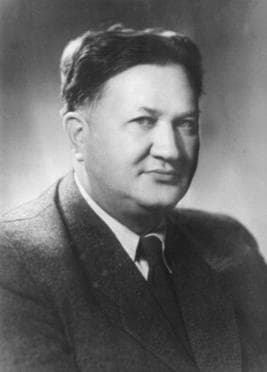
Zygmunt Wojciechowski (27 April 1900 – 14 October 1955) was a Polish historian and nationalist politician. Born in 1900 in then-Austria, he obtained a doctorate from medieval history at Lviv University. In 1925 he moved to Poznań, where he became a full professor in 1929. In 1934-1939 he became politically involved with the nationalist party Endecja. During occupation of Poland by Nazi Germany he worked in Polish underground opposing German genocide of Poles by providing underground teaching, which was banned by German state and worked on future concept of Polish borders that would provide Pol
Zygmunt Wojciechowski (27 April 1900 – 14 October 1955) was a Polish historian and nationalist politician. Born in 1900 in then-Austria, he obtained a doctorate from medieval history at Lviv University. In 1925 he moved to Poznań, where he became a full professor in 1929. In 1934-1939 he became politically involved with the nationalist party Endecja. During occupation of Poland by Nazi Germany he worked in Polish underground opposing German genocide of Poles by providing underground teaching, which was banned by German state and worked on future concept of Polish borders that would provide Poland with safety against any further German aggression. He supported an alliance with Soviet Union and after the war he continued to work as historian in People's Republic of Poland and headed Western Institute that studied former Polish territories recovered from Germany and history of Polish-German relations. He was a recipient of Commander's Cross and Officer's Cross of Order of Polonia Restituta.
0 comentarii0 reacții
Zygmunt Wojciechowskia adăugat o fotografie
acum 3 luni
R.I.P Zygmunt
Biography
Wojciechowski was born in Stryj near Lviv (Stryi, Ukraine), then Austro-Hungarian Galicia. In World War I he volunteered Piłsudski's Legion but was not deployed anymore.
In 1921, Wojciechowski began studying at the Jan Kazimierz University in Lwów, which had then just been re-incorporated in the re-created Polish state (now Lviv in Ukraine). In 1924, he obtained a doctorate in medieval history, social sciences, and economics, and became assistant professor at the Institute for Auxiliary Sciences of History. In 1924 he published his first concept of the "motherland territories" of Poland. His definition of "Polish motherland" was the areas as acquired by 10th-century Piast Poland in the era of Mieszko I and Boleslaw Krzywousty (Greater Poland, Silesia, Pomerania, Neumark, West Prussia). In 1925, he moved to Poznań, where he first was the deputy holder of the chair for the history of the political system and Ancient Polish law at Adam Mickiewicz University (UAM). The same year, he completed his habilitation with a thesis on the territorial administration of medieval settlements. He became extraordinary (non-tenured) professor in 1929, and full professor in January 1937. From 1939, he was the dean of the university's Department of Law and Economics.
0 comentarii0 reacții
Zygmunt Wojciechowskia adăugat o fotografie
acum 3 luni
R.I.P Zygmunt
Political activity Since 1934, Wojciechowski, a friend of Roman Dmowski (leader of endecja), had been one of the main ideologists of the Camp of Great Poland (OWP). He was active in the right-wing All-Polish Youth and the Liga Narodowa. In 1934 he founded the "League of Young Nationalists" (Związek Młodych Narodowców), whose aim was the foundation of an authoritarian, homogenous Polish state, and became its chairman until 1937. From 1937 to 1939 he was the chairman of the "Nation State Movement" (Ruch Narodowo-Panstwowy) In 1937 he called for a strong national state that would be democratic During his political career he opposed Dmowski and the movement he belonged to sought integration with Józef Piłsudski's sanacja faction, hoping that both main political factions in Poland would unite led by interest in well being of Polish nation However, he considered Dmowski one of the most influential persons of his life. Wojciechowski initially saw "traces of a modern national thought" in the National Socialism. He initially admired Hitler's anti-Jewish policy as a good example for Poland. He accepted the Anschluss of Austria and the Munich Agreement but became more critical of Hitler's politics in the course of time. According to Tomasz Kenar he…
0 comentarii0 reacții
Zygmunt Wojciechowskia adăugat o fotografie
acum 3 luni
R.I.P Zygmunt
Fate during German occupation
While initially able to escape Germans, he was captured by them in October 1939 and held as hostage along with other Polish intellectuals, craftsmen, politicians and students. The group was held as part of German effort to crush Polish resistance, and they were threatened with murder in case of armed resistance. Every few days, Wojciechowski was allowed to visit home. If he wouldn't return, the others would be shot. Eventually he was released two months later, due to his pregnant wife's plea. Despite his release, the family faced further reprisals, as it had to flee Poznań as initial ethnic cleansing of Poles from the region was initiated by Nazi German authorities. Wojciechowski eventually found refugee at a friend's house in Kraków.
0 comentarii0 reacții
Zygmunt Wojciechowskia lăsat un gând
acum 3 luni
Underground activity During the occupation of Poland in World War II, he was involved with the Polish underground authorities, teaching at the Uniwersytet Ziem Zachodnich ("University of the Western Territories", a part of the necessary underground education system) necessary, as all Poles were forbidden basic schooling as part of German genocide regarding Polish nation. He continued his research, and supervised his students (Zdzisław Kaczmarczyk, Kazimierz Kolańczyk) who finished two dissertations. In 1944 he also headed the Government Delegation for Poland's Science Section in the Department of Information, and briefly, after the fall of the Warsaw Uprising, he was the deputy director of the Department. As part of conspiracy during Nazi German occupation he was one of the founding members of Ojczyzna-Omega, a conspiracy movement that gathered surviving (as Germans carried out systematic extermination of Polish educated classes) Polish intellectuals, priests, journalists, lawyers and teachers, who organised charity work, secret education and worked on concepts of post-war Poland; most of the members were Christian democrats and National Democrats. Ojczyzna-Omega envisioned a post-war Poland that would be a democratic, efficiently administrated state populated mainly by Polish majority alongside Jewish population and Slavic groups. The organisation believed that Nazi Germany (which attempted a…
0 comentarii0 reacții
Zygmunt Wojciechowskia lăsat un gând
acum 3 luni
Post-war In 1945 his book "Poland-Germany. Ten centuries of struggle" (first edition 1933) was reissued. To Wojciechowski the history of Polish-German relations was coined by an eternal struggle against German aggression which was founded on a lack of the ability of Germans to cohabit peacefully with Slavs and their "biological" hatred of everything Slavic. Wojciechowski described his view of the post-war situation: "There is a new epoch of Slavic march to the west that has replaced the German Drang nach Osten. Who doesn’t understand it, won’t understand the new era and won’t see properly the place of Poland in the new international reality” Wojciechowski supported a new German-Polish border that would allocate the whole Oder Lagoon up to the river Peene to Poland. He resumed teaching at UAM. He became a member of the Polish Academy of Learning (PAU) in 1945 and of the Polish Academy of Sciences (PAN) in 1952. In 1944, he established the Western Institute (Instytut Zachodni), an institution dedicated to studying the Polish history of what would become the Recovered Territories. Initially in Warsaw, the institute's seat moved to Poznań in 1945. Wojciechowski remained its director until his death in 1955. In 1945, Wojciechowski founded the…
0 comentarii0 reacții
Zygmunt Wojciechowskia lăsat un gând
acum 3 luni
Recognition
He was a recipient of Commander's Cross and Officer's Cross of Order of Polonia Restituta.
In 1984 the Western Institute was eventually named in his honor. In Poland Zygmunt Wojciechowski is recognised today as exceptional historian, and one of people who formed Polish intellectual elites.
0 comentarii0 reacții
Zygmunt Wojciechowskia lăsat un gând
acum 3 luni
Publications
Ustrój polityczny ziem polskich w czasach przedpiastowskich Lwów 1927
0 comentarii0 reacții
Zygmunt Wojciechowskia lăsat un gând
acum 3 luni
Początki immunitetu w Polsce 1930
Polska nad Wisłą i Odrą w X wieku. Studium nad genezą państwa Piastów i jego cywilizacji [Poland on the Vistula and Oder in the 10th century: A study on the genesis of the Piast state and its civilization], Warszawa: Nasza Księgarnia, 1939
Państwo polskie w wiekach średnich. Dzieje ustroju 1945
Polska-Niemcy. Dziesięć wieków zmagania [Poland-Germany. Ten centuries of struggle]. Poznań: Wydawnictwo Instytutu Zachodniego, 1945
Polska-Czech. Dziesięć wieków sąsiedztwa Poland-Czechs. Ten centuries of neighbourhood. 1947 (with Tadeusz Lehr-Spławiński, Kazimierz Piwiarski)
Państwo polskie w wiekach średnich. Dzieje ustroju [The Polish state in the Middle Ages: The history of its political system], Poznań: Poznań Księgarnia Akademicka, 1948
Zygmunt Stary (1506-1548) Sigismund the Old (1506–1548)], 1946, re-issue Warszawa: Państwowy Instytut Wydawniczy, 1979
(as editor) Poland's Place in Europe. Poznań: Wydawnictwo Instytutu Zachodniego, 1947