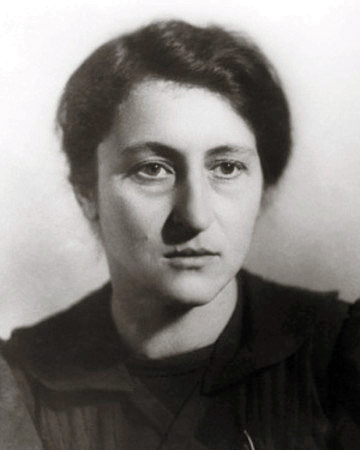
Wanda Wasilewska (Polish pronunciation: [ˈvanda vaɕiˈlɛfska]), also known by her Russian name Vanda Lvovna Vasilevskaya (Russian: Ва́нда Льво́вна Василе́вская) (21 January 1905 – 29 July 1964), was a Polish and Soviet novelist and journalist and a left-wing political activist. She was a socialist who became a devoted communist. She fled the German attack on Warsaw in September 1939 and took up residence in Soviet-occupied Lviv and eventually in the Soviet Union. She was a founding member of the Union of Polish Patriots and played an important role in the creation of the 1st Tadeusz Kościuszko
Actualizări recente
Wanda Wasilewskaa adăugat o fotografie
acum 7 ore
R.I.P Wanda
Before World War II Wasilewska was born, the second of three daughters, on 25 January 1905 in Kraków, Austrian Poland. Her father was Leon Wasilewski, a Polish Socialist Party (PPS) politician and first foreign minister of the newly re-emerging independent Poland. Her mother, Wanda Zieleniewska, was also a PPS member and the young Wasilewska had gotten to know the party leaders at home. From 1923, she studied Polish language and Polish literature at the Jagiellonian University in Kraków, where several years later she acquired her doctorate. While studying, she became involved with the Union of Independent Socialist Youth (ZNMS, allied with the PPS) and the Society of Workers' Universities. From the early 1930s, Wasilewska was strongly involved in women's issues and gender equality. Her attitude was exemplified by her own personal conduct as well as her work in the Women's Section of the PPS. However, she eventually chose to emphasize in her activism the broader class issues, remarked that it was easier to deal with men and criticized Warsaw feminists for coloring their movement with "feminism of half a century ago". Wasilewska joined the PPS as a student. She was a member of the main party council in 1934–37. She…
0 comentarii1 vizualizări0 reacții
Wanda Wasilewskaa adăugat o fotografie
acum 7 ore
R.I.P Wanda
During World War II After the Invasion of Poland by Nazi Germany in September 1939, Wasilewska, like hundreds of thousands of other Poles, fled to the east and following Stalin's directions ended up in Lviv (after the Soviet invasion of Poland a part of the Soviet-occupied zone). Like other Polish citizens, she soon automatically became a Soviet citizen, but unlike many she was enthusiastic about the historic turn of events and Poland's prospects under the Soviet tutelage that she expected; she thought it would promote both the national and social liberation of Poles. Wasilewska officially joined as a member the (All-Union Communist Party (Bolsheviks) already in September 1939. According to Khrushchev, the Soviets worked with Wasilewska on organizing the Polish intelligentsia members present in their zone and turning them into Soviet allies. Several dozen Polish literary figures indeed joined the Federation of Soviet Writers of Ukraine in the fall of 1940. Wasilewska prevented a complete Ukrainization of the University of Lviv: because of her intervention part of the Polish prewar faculty remained there and teaching in Polish was retained in some departments. Also in 1940, Wanda Wasilewska participated in the production of "Wind from the East" – a propaganda film…
0 comentarii1 vizualizări0 reacții
Wanda Wasilewskaa adăugat o fotografie
acum 7 ore
R.I.P Wanda
Wanda Wasilewska (Polish pronunciation: [ˈvanda vaɕiˈlɛfska]), also known by her Russian name Vanda Lvovna Vasilevskaya (Russian: Ва́нда Льво́вна Василе́вская) (21 January 1905 – 29 July 1964), was a Polish and Soviet novelist and journalist and a left-wing political activist. She was a socialist who became a devoted communist. She fled the German attack on Warsaw in September 1939 and took up residence in Soviet-occupied Lviv and eventually in the Soviet Union. She was a founding member of the Union of Polish Patriots and played an important role in the creation of the 1st Tadeusz Kościuszko Infantry Division. The division developed into the Polish People's Army and fought on the Eastern Front during World War II. Wasilewska was a trusted consultant to Joseph Stalin, and her influence was essential to the establishment of the Polish Committee of National Liberation in July 1944 and to the formation of the Polish People's Republic.
0 comentarii1 vizualizări0 reacții
Wanda Wasilewskaa adăugat o fotografie
acum 7 ore
R.I.P Wanda
After the war, Wasilewska decided to stay in the Soviet Union and retired from public life, thus rejecting the opportunity for becoming an active member of the political elites in communist Poland. She was involved in a long-term relationship with Ukrainian playwright and Soviet state official Oleksandr Korniychuk, with whom she moved to Kiev. Wasilewska had limited Russian and Ukrainian language abilities, but was a member of the Supreme Soviet for six terms. She often visited Poland, where a room was kept for her use at the villa of Broniewska in Warsaw. She was highly influential in the affairs of Poland and consulted by the country's top leaders, including Bierut and Berman. Especially before Gomułka's ascent to power in 1956, Wasilewska's visits followed invitations from the authorities; afterwards they were less frequent and of a more private character. According to communist historian Andrzej Werblan, Wasilewska and Gomułka were politically incompatible. She made frequent foreign trips as an activist in the peace movement, including one to Stockholm in 1956.
0 comentarii1 vizualizări0 reacții
Wanda Wasilewskaa publicat o actualizare
acum 7 ore
Wasilewska wrote to her friend Nikita Khrushchev to complain of the 1955 publication of Poemat dla dorosłych ('A Poem for Adults') by Adam Ważyk, which she saw as one of the manifestations of the increasingly present in Poland anti-socialist agitation. However, after Khrushchev's assumption of the Soviet leadership and his reforms, she seemed primarily preoccupied with her family affairs and by the tending her grandson Peter in particular. She was often visited by family members and friends from Poland. Among other guests Wasilewska and Korniychuk entertained was the writer John Steinbeck. She spent time with her husband in their dacha not far from Kiev, but the relationship eventually deteriorated. She developed heart and circulatory problems. Wanda Wasilewska died on 29 July 1964 in Kiev and is buried in the Baikove Cemetery. Oleksandr Korniychuk, who outlived her by several years, was buried there in another grave.
0 comentarii1 vizualizări0 reacții
Wanda Wasilewskaa publicat o actualizare
acum 7 ore
Role, assessments, influence and works Wasilewska has "her place in Polish collective memory as a symbol of the establishment of the communist order after World War II". Brought up in a patriotic, intellectual, left-wing but anti-Russian Polish establishment environment, Wanda Wasilewska gradually developed a communist identity and revolutionary outlook, to become a theorist, ideologue and promoter of communism in Poland. She was "strongly embedded in the historical and geopolitical context of her era" and blurred in her daily activities and works she produced the distinction between the public or political, and private aspects of her life. The transgressions she engaged in as a radical leftist were of many dimensions and involved transcending the borders of her gender, nationality, and social class (it amounted to "rejecting superstition", as she put it).
0 comentarii1 vizualizări0 reacții
Wanda Wasilewskaa publicat o actualizare
acum 7 ore
Wasilewska writings were heavily socially and ideologically engaged. She accused Sanation Poland of gross discrimination of its citizens based on their rank (the elites vs. the masses) and ethnicity. She pointed to a combination of economic and nationalistic oppression of the working classes and the minorities by the industry and land owners and by people of the dominant Polish language and culture. With the end of the war, Wasilewska removed herself from the position of power to assume other roles. As Władysław Gomułka saw it, later she must have had regretted the decision she made but had to live with it. She "played her role till the end", but in a letter to her mother complained about the many ailments she suffered from, ascribing them all to "nerves". Agnieszka Mrozik speculates that Wasilewska's diseased body expressed her reaction to "the corset of a monument which she was given to wear" and that she may have been "stuck" in a role which "involved – apart from the appearance of a fulfilled activist and writer – the appearance of a happy woman". To some degree, Wasilewska might have been pushed out or discouraged from continuing political career in postwar Poland, because of…
0 comentarii1 vizualizări0 reacții
Wanda Wasilewskaa publicat o actualizare
acum 7 ore
Wasilewska was one of the first Polish writers to follow the rules of socialist realism. She wrote several novels and a handful of poems. Oblicze Dnia ('The Face of Day') novel had the printing of its book edition stopped by Sanation censorship (it had already been issued in installments in the leftist Naprzód periodical). After an intervention by Wasilewska's father, the book was published in an expurgated form. However, a Russian translation and edition were soon produced. Around 1936, on several occasions the Soviet Embassy paid Wasilewska compensation for her books published in the Soviet Union. In the Soviet Union, where Wasilewska's literary works were much more appreciated than in Poland, the material she produced, including elements of her personal story, were turned, in accordance with the convention of socialist realism, into a model to be followed by the population. In the early 1950s, Wasilewska and Korniychuk wrote a libretto for Kostiantyn Dankevych's opera Bohdan Khmelnytsky. After it became a target of ideologically based criticism, the authors submitted self-criticism and revised their work. Wasilewska was a triple recipient of the Stalin Prize for literature (1943, 1946, 1952). During Stalin's lifetime she was considered a classic writer of Soviet literature and…
0 comentarii1 vizualizări0 reacții
Wanda Wasilewskaa publicat o actualizare
acum 7 ore
Bibliography Aleksander Wat, Mój Wiek Warszawa 1990 Helena Zatorska, Wanda Wasilewska, Warszawa 1977 Adam Ciołkosz, Wanda Wasilewska: dwa szkice biograficzne, Polonia Book Fund: Londyn 1977 Eleonora Salwa-Syzdek, Działalność Wandy Wasilewskiej w latach drugiej wojny światowej, Warszawa 1981 Ed. Eleonora Salwa-Syzdek, Wanda Wasilewska we wspomnieniach, Warszawa 1982 Eleonora Syzdek, W jednym życiu - tak wiele, Warszawa 1965 Zmarła Wanda Wasilewska. Nowiny, p. 1–2, No. 179, 30 July 1964