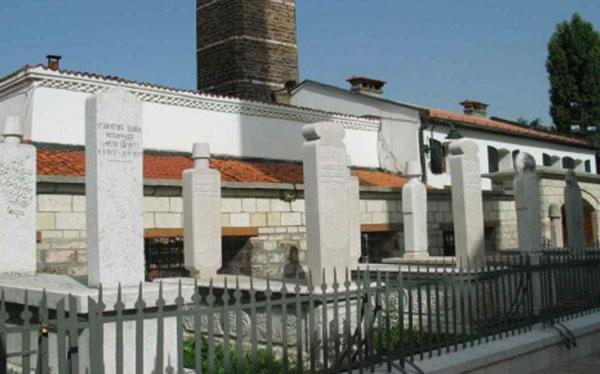
Gazi Husrev-Beg Mosque
📍 Sarajevo, Sarajevo, Bosnia and Herzegovina
About the cemetery
Photo gallery
5 photosPhoto source: Wikimedia Commons (CC)
Contact & location
- Locality: Sarajevo
- County: Federation of Bosnia and Herzegovina
- Sarajevo
- Get directions ↗
QR code
Scan to open the cemetery page. You can place it at the entrance or on an information board.
↓ Download QRDeceased (13)

Ali beg Firdus
1864 – 1910
Gazi Husrev-Beg Mosque
The earlier tombstone of Ali-beg Firdus completely disintegrated over time. The sarcophagus now has new tombstone with a Latin inscription: "Ali-beg Firdus (1864 - 1910)" An inscription from earlier tombstone has been preserved, which is sung in verse in the Turkish language and translates to: Al-Fatiha. Hanedan (benefactor) of Bosnia, Livnjak Firdus Ali-beg, He died in the city of Sarajevo... (here the text was damaged) He was engaged in endowment and educational affairs of Muslims And he was the president of the first Parliament But time also destroys his life. He was a well-bred man And as such a well-wisher to his people. God, may his grave be illuminated until the day of judgment And may all his sins be forgiven. The supplicant arrived and pronounced the chronogram, Enverijo: The castle of Paradise of Firdevsa may be the resting place of Firdus Jumade-l-ahira 1328."

Safvet beg Bašagić
1870 – 1934
Gazi Husrev-Beg Mosque
On the headpiece there is an epitaph in a poem in Turkish on one side, and an inscription in prose, also in Turkish, on the other. On the foot sight there is an inscription in Latin, in Bosnian language. The caption text in the song reads: "He (God) is eternally alive. A famous poet, of high spirit, to awaken the people, Mirza Safvet, he fought like a lion. He stood with a pen in his hand at the vanguard of the people's interests this famous emir, And in enlightened circles he was at the forefront. And he offered his help to everyone. He spent his life spreading the beautiful book, So his works resemble a fresh garden. Numerous poems and works full of wisdom He left as a gift to every brave Safvet. Both old and young read his poems with pleasure So a beautiful memory will always live on in the people On him. This beautiful full chronology was uttered on the occasion of his death: The nightingale, with a beautiful voice, flew away to the high heaven. Year 1351." The second, smaller, chr

Safvet beg Bašagić
1870 – 1934
Gazi Husrev-Beg Mosque

Mehmed Džemaludin ef. Čaušević
1870 – 1938
Gazi Husrev-Beg Mosque
There are two inscriptions on the head sight. The external inscription is in Arabic and translates to: "He (God) is eternally alive. Rahmetli reisu-l-ulema hadji Mehmed Džemaludin Čaušević, was born on the 4th of Shawwal, 1287 AH, and died on 26 Muharram 1357 AH. For his soul in the name of Allah (read) Fatiha." The inside inscription is written in Bosnian transliteration in Arabic (Arabic letters) and reads: "Merhum Džemaludin Čaušević, Reisu-l-ulema was born on December 28, 1870 in Arapusa (Bosanska Krupa), he moved to the afterlife on March 28, 1938 For his soul Fatiha."

Mehmed Spaho
1883 – 1939
Gazi Husrev-Beg Mosque
On the headpiece, with a fez, two inscriptions in the Arabic language are engraved on both sides of the sight, while on the foot, there is an inscription in our language, in Latin. The text of the inscription carved in 18 oblique lines on the front side of the head sight reads: "Everything in this world is transient. Stand by the numb and silent graves And list everyone you know who was alive from the poor and the excellent. Think and shake off all the desires that can deceive you and live freely without them. Don't you see how unfaithful time destroys everything that stands intact. Well, don't you see how time treats the owner of this grave, High Minister Mehmed. Death suddenly snatched him when he was comfortably enjoying himself in honor and lordship. And when his supporters obediently followed him and followed his opinion. In the year one thousand three hundred and fifty-eight, he lay down in the grave. May he receive thousands of greetings from us, and from the Merciful God an imm

Gazi Husrev beg
1480 – 1541
Gazi Husrev-Beg Mosque

Mustafa beg “Mustajbeg” Fadilpašić
1830 – 1892
Gazi Husrev-Beg Mosque
On one, wider side of the headpiece, with a turban, is carved an inscription in a poem in the Turkish language: "Ah, death. A prominent person in Sarajevo, a descendant of the ešraf (nobility), His last name was Fadilpašić and he was a very pious person. Emir Mustafa Hajrudin was valued and respected. When he receives the call "come back", he gladly responds to the voice, For in his lifetime he laid up provision for Eternity, And surrendered his soul, may his place be in paradise. May the Lord (God) forgive his sins and illuminate his grave. So that he can permanently enjoy a protected paradise. Pray reciting the Fatiha for all Muslims And think that you too will drink the cup of death. Nahif, say the dzhevher tarikh (decorated inscription) and ask like this: God, take Mir-Hajrudin to your mercy. The year 1310."

Murat beg Tardić
1545
Gazi Husrev-Beg Mosque
" When Murad Bey leaves this world, whoever hears it will say: May God bless Murad's soul"
Mahmut beg Fadilpašić
1853 – 1912
Gazi Husrev-Beg Mosque
The earlier tombstone of Mahmut -beg have completely disintegrated, so now new ones with a Latin inscription have been placed over the sarcophagus: "Mahmut - beg Fadilpašić (1853 - 1912)" The inscription from earlier tombstone has not been preserved.

Naim ef. Hadžiabdić
1918 – 1987
Gazi Husrev-Beg Mosque

Sulejman ef. Kemura
1908 – 1975
Gazi Husrev-Beg Mosque

Fehim ef. Spaho
1877 – 1942
Gazi Husrev-Beg Mosque
Mehmed ef. Mutevelić
1823 – 1853
Gazi Husrev-Beg Mosque
Ah, death. Muteveli of Gazi Husrev-bey's waqf properties, He did not seek the wealth and glory of this world, In his young days he entered the order of the Nakshi, Paying no attention to the glitz and glory. Throughout his life he was preoccupied with the mention of God, And was always ready to leave this world, So he finally sent his soul to Heaven with joy. With menkut (carved) letters, Zuhdi told him the chronogram of death: Saying "Ja Hajj" (O living God) Mehmed Rizai passed away to God's mercy. Year 1269." The text of the smaller inscription on the other side of the niche describes the social status of the deceased and reads: "Pillar of the Sarajevo eshrafa (nobility) and hanedan (benefactor), The pride of his peers, an excellent student, The bright appearance of Mehmed-effendi, He is still in the prime of his youth, By the decree of the Merciful, Deprived his soul of earthly shackles. His soul flew into eternity. I told him the chronology of death in jewel letters, Sun'ija, remem